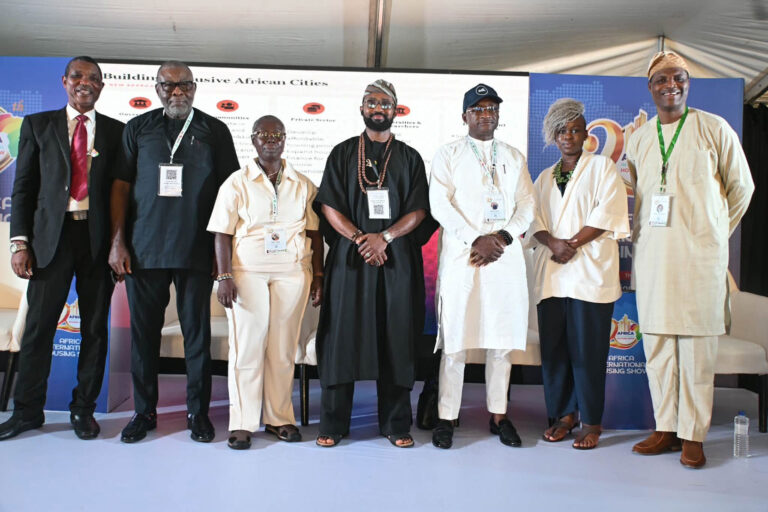
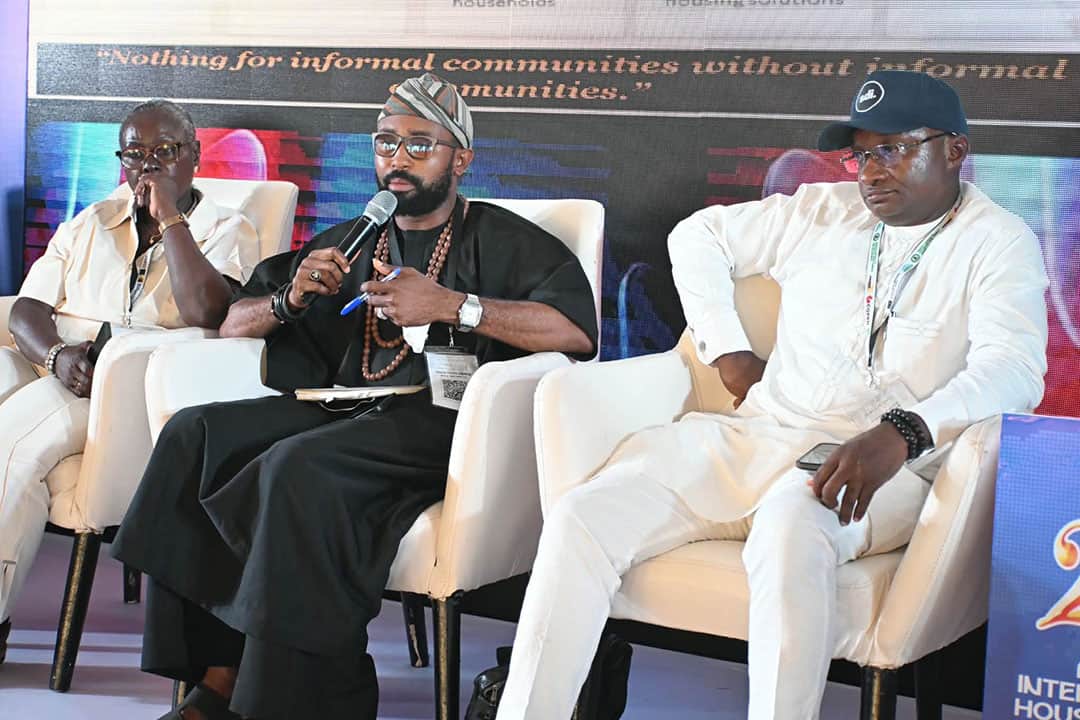
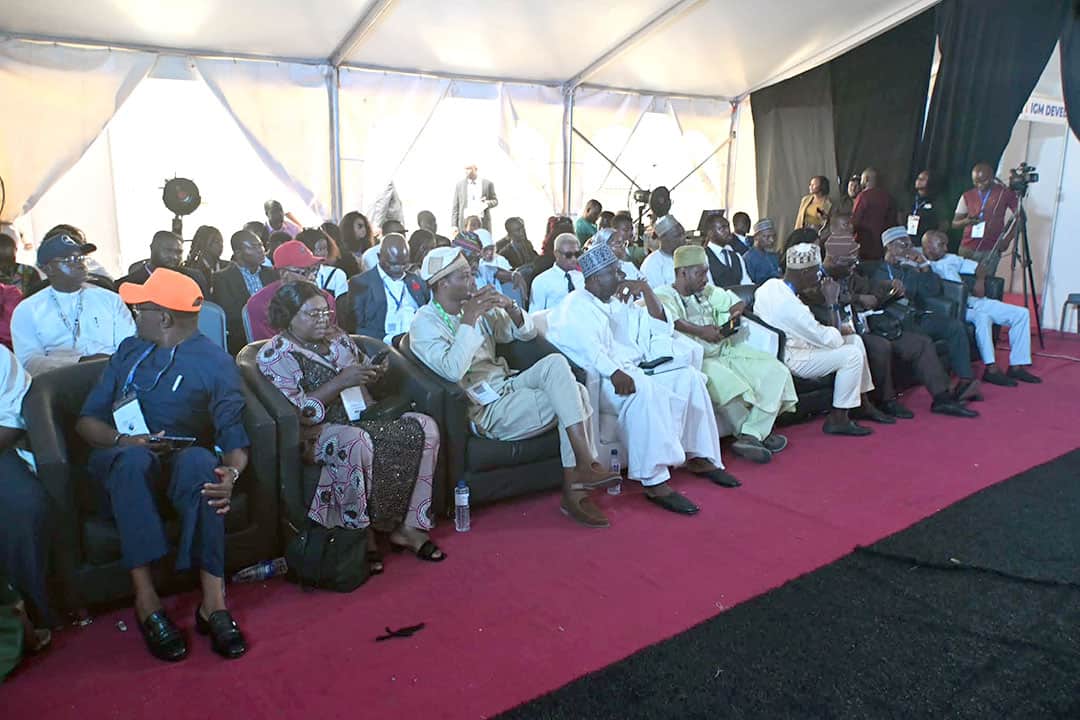
Representatives from the Shantytown Empowerment Foundation (SHEF) and the SDI Nigeria Federation joined a panel on Housing Solutions for Low Income and Informal Workers in Africa. This was part of the 20th anniversary of the Africa International Housing Show (AIHS) in Abuja, Nigeria.
The theme of the show was Financing Low-Income and Informal Sector Housing for Africa. Policymakers, housing professionals, partners and community representatives came together to look at practical ways to deliver inclusive and affordable housing.
Esther Bimbo Oshobe, President of the SDI Nigeria Federation, said the event gave the Federation a chance “to speak out and address homelessness, loss of livelihoods, separation of families, and loss of both adults and children, all caused by forced evictions by government.”
Bimbo was speaking about the mass evictions and demolitions in the Makoko, Oko Agbon and Sogunro communities in Lagos. More than 40,000 people were displaced in Makoko.
“When we say plan with us, not for us, it means we should be involved. We spoke about forced eviction not being the solution. So much research has already been done. We keep hoping for the best. If 70 to 80 percent of the population live in slum communities, why not give us a place among the decision makers?” she asked.
Rasheed Shittu, Executive Director of Shantytown Empowerment Foundation, said, “sustainable housing must be built on real community participation, secure land tenure, access to basic services, and partnerships that recognise the knowledge and contributions of residents living in informal settlements.”
Bimbo asked, “Where are the low income homes that we can afford? Why push us onto the streets by forcing us out of our homes? Slum upgrading can be done with us, by us, if government gives support and resources. Forcing us out of our homes, with nowhere to go but under bridges, only creates more slums.”
AIHS 2026 delegates adopted a 24-point Abuja Declaration. It calls on African governments to make affordable housing a priority, and to develop, finance and monitor national housing strategies across the continent, particularly for low-income earners and workers in the informal sector.
Rasheed thanked the organisers for creating the platform. “We look forward to continued collaboration in advancing housing policies and investments that leave no one behind,” he said.
“I hope government looks at the different suggestions we made. Having our voices in the conversation is a great step. We gave examples from other SDI affiliate countries, and we hope for better results.”
Bimbo concluded, “We are like water. We will always find our way.”
The Abuja Declaration on Housing Solutions for Low-Income and Informal Workers in Africa
Following extensive deliberations during the 20th Anniversary (Legacy Edition) of the Africa International Housing Show held from 13–18 July 2026 in Abuja, Nigeria, under the theme, Housing Solutions for Low-Income and Informal Workers in Africa, participants comprising Ministers, Governors, Members of Parliament, Mayors, development finance institutions, multilateral agencies, UN-Habitat, investors, mortgage institutions, housing cooperatives, developers, professionals, researchers, financial institutions, manufacturers, youth leaders and civil society organisations resolved as follows:
We hereby declare that:
- Affordable housing must be recognised as a strategic national development priority and a key instrument for poverty reduction, job creation and economic growth.
- Every African country should develop a National Affordable Housing Strategy with measurable annual housing delivery targets.
- Governments should increase annual budgetary allocations to affordable housing and supporting infrastructure.
- African governments should prioritise housing for low-income earners, informal workers, women, youth and persons living with disabilities.
- Land administration systems should be modernised through digitalisation, simplified land registration and reduced transaction costs.
- Governments should establish fast-track approval systems for affordable housing developments.
- Housing finance institutions should develop mortgage products specifically designed for informal sector workers using alternative methods of assessing income.
- Housing cooperatives should become a major delivery platform for affordable home ownership across Africa.
- African governments should strengthen partnerships with pension funds, insurance companies, sovereign wealth funds and private investors to finance affordable housing.
- Development Finance Institutions should expand concessional funding for affordable housing projects across Africa.
- Governments should encourage local production of building materials to reduce construction costs.
- African countries should promote innovative and alternative building technologies that lower housing costs while maintaining quality.
- Governments should provide tax incentives and fiscal support for developers delivering verified affordable housing.
- Housing policies should deliberately promote women and youth participation in housing development, ownership and construction value chains.
- African cities should prioritise slum upgrading, urban regeneration and climate-resilient settlements instead of forced evictions.
- Digital technology, Artificial Intelligence and data systems should be integrated into housing planning, land management and mortgage administration.
- Transparency, accountability and anti-corruption measures should be strengthened throughout the real estate sector.
- Strong collaboration among governments, the private sector and development partners should become the primary model for housing delivery.
- African governments should harmonise housing policies and encourage cross-border investment in real estate.
- AIHS should establish an Annual Africa Affordable Housing Performance Index to monitor the implementation of these resolutions.
- AIHS should launch an Africa Housing Innovation Network to support research, innovation and knowledge exchange.
- AIHS should continue recognising outstanding individuals and institutions through the 100 Champions of Affordable Housing in Africa initiative.
- Participants call on the African Union to adopt affordable housing as a continental development priority and encourage Member States to implement the recommendations of this Declaration.
- Participants reaffirm their commitment to work collectively towards ensuring that every African has access to decent, safe, affordable and sustainable housing.
Conclusion
Participants expressed appreciation to the Government and people of Nigeria, the Federal Ministry of Housing and Urban Development, development partners, sponsors, exhibitors, speakers, volunteers and the Board of the Africa International Housing Show for successfully hosting the 20th Anniversary (Legacy Edition).
The communiqué was unanimously adopted in Abuja, Federal Republic of Nigeria, on 18 July 2026, and shall be known as the Abuja Declaration on Affordable Housing for Low-Income and Informal Workers in Africa.
This declaration is AIHS’s signature legacy document and was presented to: The President of Nigeria, The African Union, UN-Habitat and African Ministers responsible for Housing.