11-14 May 2026 | Manila, Philippines
For over 30 years, the SDI Network has demonstrated that organised communities, in partnership with local government and with the right resources placed directly in their hands, can lead their own settlement upgrading.
This is the foundation of locally-led Climate Adaptation.
Slum upgrading is Climate Action
Upgrading informal settlements, through sustainable housing, resilient infrastructure, and tenure security, directly addresses structural conditions which make us disproportionately vulnerable to extreme heat, flooding, water scarcity and severe weather.
In-situ upgrading avoids the harms of forced evictions and displacement, while providing affordable, context-specific solutions already being demonstrated across our networks. Climate resilience and local adaptation begins with secure tenure. Donors must educate themselves of our realities and recognize that upgrading is climate action, before prescribing solutions.
Work with informality, not against it
Resilient cities, inclusive development and adaptation goals cannot be achieved without engaging the realities of informal settlements. Governing officials must recognize that slum dwellers are not a barrier to achieving adaptation goals, we are integral to its success!
Agreed metrics to track the Global Goal on Adaptation must include informal settlements as priority sites of climate intervention and must respect the agency and leadership of local residents.
Institutionalise community knowledge and data
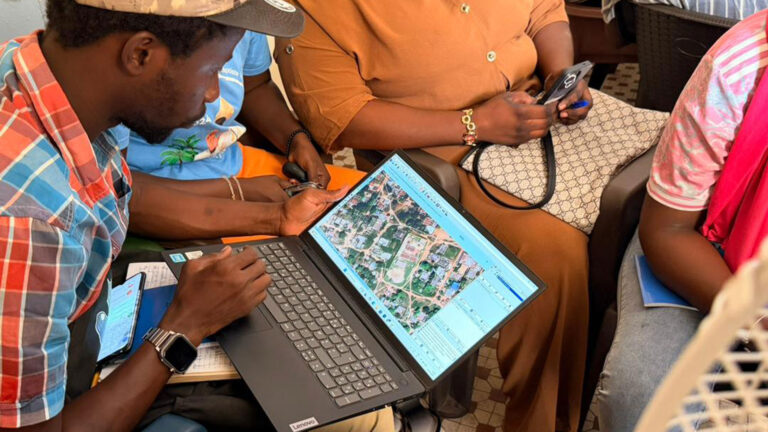
Our data and experience are valid and necessary inputs for better climate models and climate action planning, as well as scientific processes such as IPCC assessments. Our slum dweller federations gather detailed co-produced data and evidence on risks, vulnerabilities and solutions, mapping climate impacts while addressing critical data gaps overlooked by formal systems. This knowledge must be institutionalised in adaptation planning, early warning systems and global monitoring processes.
Channel climate finance directly to the ground
Climate finance must be flexible, accessible to community led organisations and aligned with local development priorities. Current restrictions and topdown mechanisms prevent resources from reaching marginalised communities such as women, the youth and people living with disabilities who are already taking action with their own scarce resources.
International actors also overlook the impact of local savings and loans schemes, such as SDI’s Urban Poor Funds and savings groups, and other community managed funds which play a critical role in supporting resilience and climate action in informal settlements. Finance must support fundamentals such as dignified housing, basic services, and tenure security while applying the principles of locally led adaptation to scale solutions and strengthen resilience. The costs of inaction are far higher than the costs of proactive investment.
We demand recognition that slum dwellers are not marginal to climate adaptation, but central to its sustainability and impact!
Devolve finance to communities
Direct, unbroken funding to community-managed funds such as the Urban Poor Funds — not through intermediary-heavy mechanisms that consume resources before they reach the ground.
Recognise citizen data
Accept community-generated evidence — VRATs, savings records, community risk maps — as credible input in national climate plans, GCF applications and adaptation finance decisions.
Count slum upgrading as adaptation
The same infrastructure such as drainage, secure tenure, resilient housing, which reduces vulnerability to floods and heat must be eligible for adaptation finance.
“We live with problems, so we must lead solutions.”
The most effective climate solutions are not imported, they are born and led by the people who live in and understand their own settlements.
Halala Federation, halala!
The SDI Network will be represented at CBA20 by affiliates from Ghana, Kenya, Senegal, South Africa, Tanzania, the Philippines, Uganda, Zambia, Zimbabwe and the SDI Secretariat.
A special thank you to the SDI Philippines Alliance, the Homeless Peoples’ Federation Philippines, Inc. (HPFPI), a national federation of the urban poor in the Philippines , and the Philippine Action for Community-Led Shelter Initiatives, Inc. (PACSII), the federation support NGO, for co-hosting CBA20.
11 May, 2026
Between data and doorsteps: bridging global science and local reality for urban climate resilience
10:30am – 11:30am (PST)
Monet ballroom 1 (2nd Floor)
Accountability roundtables: Lessons from the Generating Ambition for Locally Led Adaptation programme
11:30am – 12:30pm (PST)
Renoir (3rd Floor)
Nature-based Urban Solutions for Urban Resilience
3:30pm – 5:00pm (PST)
Monet ballroom 1 (2nd Floor)
12 May, 2026
Bridging the acceptability and accessibility gap to clean cooking in informal settlements
11:00am – 12:30pm (PST)
Versailles tent (7th Floor)
Heat, health and dignity: urban heat stress as a systemic risk amplifier
1:30pm – 3:00pm (PST)
Monet ballroom 1 (2nd Floor)
Download pdfs below: