Communities Drive Progress in Slum Sanitation


By Diana Mitlin and Noah Schermbrucker
The Sustainable Development Goals (SDGs) make a clear commitment to universal sanitation. This is to be welcomed. But for the SDGs to be realized, they must be grounded in practical actions that can be replicated affordably, rapidly, and at scale.
The challenge is evident in the failure to achieve the sanitation targets outlined in the SDGs’ predecessor, the Millennium Development Goals. The WHO/UNICEF Joint Monitoring Programme report for 2015 tells us that the percentage of the African urban population with access to improved sanitation increased by just one percent between 1990 and 2015, from 39 to 40 percent.
In absolute terms this means that almost 100 million urban citizens did gain access to improved sanitation during this period – but it also means that 225 million urban sub-Saharan African are still in need.
For those living in the highest-density settlements, standards for universal sanitation are problematic. Present definitions of “improved” sanitation take no account of population densities and risks like water table contamination and the flooding of fecal sludge over pathways, yards, and playgrounds – obvious health risks that incur massive costs both locally and nationally.
In the face of such staggering needs, and existing development plans and programs which struggle to address them affordably and at scale, slum-dweller federations in the Shack / Slum Dwellers International (SDI) network have been working with local governments to explore workable alternatives.
SDI’s slum dweller President Jockin Arputham has spent so much of his life committed to this issue that, as he says, “I’m known world over as ‘Toilet Man’. In South Africa, where it’s a stigma to say ‘toilet’, I made them talk about it. In the United Nations, I built a demonstration toilet in the UN plaza.”
Progress has been made. In Mumbai, a partnership between government and SDI’s Indian Alliance has residents managing toilet blocks in their communities. One thousand toilet blocks have been built by the Alliance, providing 20,000 seats and one million users – roughly half of those in need within the Mumbai Metropolitan Region.
In Blantyre, Malawi, both SDI members and the wider community have provided over 700 eco-sanitation units benefitting 2,300 households. Some 14,000 people (both landlords and tenants) share these facilities. Hundreds more households in Zambia and Zimbabwe have replicated this design, while in Namibia communities have saved, paid for, and installed their own sewerage pipes linking to trunk services.
In Dar es Salaam, the Tanzanian SDI Alliance has been drawing on the experiences of the Orangi Pilot Project in Karachi, Pakistan, to fine-tune designs for a simplified sanitation system that is already providing facilities for approximately 100 households.
What have we learned? When community members refuse to accept the status quo and innovate new ways of organizing, sanitation provision can improve.
The Indian Alliance was told that community toilets were unworkable – they proved these critics wrong. When governments, especially local governments, are prepared to work with organized local communities, then new solutions can be found. Community exchanges can test and spread these solutions.
But financing is needed to scale up. Community members are willing and able to pay for sanitation, but they can only contribute so much – for low-income families, anything more than US$4 a month per household is unaffordable. In SDI’s experience, capital is needed for these infrastructure costs. The best option is subsidized financing, but where this is not available SDI groups have made sanitation investments using low-interest loans.
Sanitation also cannot be dealt with in isolation. For sanitation investments to be scaled effectively and efficiently, water provision, drainage, and improved land tenure security are all important.
Different solutions are needed in the diverse contexts apparent throughout the Global South. SDI groups organize themselves at the local level, gather information on the needs of slum dwellers, negotiate with local government, and design solutions that work in their context – always prioritizing the poorest members in a community.
The local communities that make up the SDI alliances in 34 nations across the Global South do not understand why professional development assistance agencies do not support their work.
In so many places, communities see development agencies implementing small sanitation projects that are never going to address the massive needs. They see projects captured by landlords because the local context was misunderstood; they see corrupt contractors inflating their invoices; and they see poor management of facilities that soon fall into disrepair.
What are the steps forward? A first step is implementing suitable monitoring systems to collect accurate baseline information in communities. SDI has information on the sanitation situation in over 6,000 informal settlements. In SDI’s experience, such information helps communities establish their priorities and helps them to build relationships with their local governments.
Importantly, community-gathered data consistently emphasizes the priority slum communities place on improving access to sanitation, in settlements from Mumbai to Accra.
In partnership with like-minded organizations and governments, SDI is working to help achieve the SDGs by generating scalable, affordable, and environmentally sustainable sanitation solutions for the world’s rapidly growing slum dweller population. We believe that community involvement in the design, implementation, management, and monitoring of this agenda is essential, and non-negotiable.
Takeaways from New York: Reflecting on the Path to Habitat 3
Upon her return from the UN Sustainable Development Summit in New York City, Beth Chitekwe-Biti shared some key takeaways on SDI’s participation in the processes and activities surrounding the post-2015 development agenda and Sustainable Development Goals. Beth highlighted in particular the challenges of grassroots organisations operating within such formal systems, the need to target city governments for implementation of the SDGs, and the obvious links between implementation and the work of SDI, particularly around the Know Your City campaign, which calls for community-driven data collection as the basis of active partnerships between organised communities and their city governments in order to co-produce inclusive upgrading and development solutions:
“The SDGs on paper seem an improvement. But of course it’s about how much political will there is on the ground to actually create tangible benefits to the urban poor. There seems to be a commitment to get the urban poor involved, but there is always a chasm between intention and what actually happens.
The systems seem very formal, so you are forcing grassroots people to be quite formal in how they work and engage with each other… I wonder if this really allows for creative engagement between different grassroots organisations and whether this really works with getting the grassroots voice heard in the UN. But at least the space if there for us to use the best way we can…
…Some of these commitments are pitched too much at the national level when it is really city government that will make a difference. This was emphasised at the Cities Alliance Joint Work Programme event, but is missing in a lot of other discussions. This fits in with SDI’s Know Your City message and hopefully governments who sign on will realise that it is at the city level that things really need to be implemented.”
—
To read more, and listen to an excerpt from Rose Molokoane’s talk at an even on implementation of the SDGs, click here.
Less Talk, More Walk: Rose Molokoane on Localising Implementation of the SDGs


Last week New York City was buzzing with events surrounding the United Nations Sustainable Development Summit for the post-2015 development agenda and the Sustainable Development Goals (SDGs), which were formally adopted on the first day of the summit. SDI’s Rose Molokoane and Beth Chitekwe-Biti were in New York City for the week and participated in a number of events, many of which focused on how actors in the development sector – particularly urban development – can effectively work together to implement the SDGs.
Rose Molokoane was invited to speak at a high level plenary and workshop on “the implementation pathway for the post 2015 development agenda and its SDG on cities and human settlements” hosted by the UrbanSDG Campaign. In her talk, Rose addressed the importance of productive, effective partnerships between organised communities of the urban poor and local and national governments in the planning and implementation of development priorities. She emphasised the frustration that is building in communities after more than twenty years of global conferences and forums with little change on the ground:
“…It is really creating an issue of depression to us as the people at the community because we are very happy to listen to you when you say community participation. What kind of participation are we talking about? Is it participation of coming here, sitting here, listen to Rose Molokoane making noise then after that Rose goes back to South Africa and nothing happens? Or is it participation of saying let’s create the forums that will continue to happen even after the SDGs and the Habitat 3s; where we go back locally and sit together and say ‘What did we learn from Habitat 3?What is it that we can do together?’ and the important part is planning, information, and recognition of what it is the people are doing on the ground and then institutionalising the forums we are talking about.”
Listen to Rose’s entire address below:
[audio m4a="https://sdinet.org/wp-content/uploads/2015/10/Rose-at-Ford-meeting-.m4a"][/audio]What might slum dwellers want from the SDGs?


Jockin Arputham has been fighting for the rights of slum dwellers for nearly 50 years. This blog is drawn from an interview by IIED’s David Satterthwaite ahead of World Habitat Day about what the Sustainable Development Goals could mean for slum dwellers.
Jockin Arputham founded the first national slum dweller federation in India in 1976 and went on to ally this with Mahila Milan, the Indian federation of women slum and pavement dweller savers. He has spent over 20 years encouraging and supporting slum and shack dwellers federations in many other countries – and he is President of Slum/Shack Dwellers International.

Making the SDGs action oriented
The SDGs promise so much but they are not action oriented. Many countries do not have the capacity to act. We see dreams of a slum-free world or a slum-free country or slum-free cities. But that is an ideal that needs strong political will, a strong and stable economy, and a conducive environment for the community. In Europe you might expect UN promises that everyone has a decent home to be met – but is this realistic for India?
Ambitions must be achievable
My ambition for the SDGs is limited to what we can do – what is meaningful, useful and sustainable – and implementable. So our goal is not slum-free cities but slum-friendly cities. Not a slum-free India but a slum-friendly India.


What does slum-friendly mean? That the SDG promises like clean water and good sanitation for all, land tenure for people, incremental housing and basic employment are met for all slum dwellers. If these five mandates are accepted, how can we set standards and measure what is or is not happening in each city? If there is also a mandate for people to participate, and take part, then set dates by which to achieve each of these. Even to achieve the more modest goals for slum-friendly cities means that governments have to do three times what they are doing now
Will action on the SDGs be any better than the Millennium Development Goals? So much high talk of all the goals in last 15 years but where are we in the goals and in their measurement? Are we setting unattainable goals with the SDGs?
We have seen government commitments made at Habitat I (the first UN Conference on Human Settlements) in Vancouver in 1976; then at Habitat II in Istanbul in 1996. At Habitat 1, there were commitments and targets for 1990 and these were not met. There have been very few tangible achievements. I was invited to go to speak at Habitat I in 1976 but the government was bulldozing the settlement where I lived, so I stayed in Mumbai where I had fought this threat for 10 years.
Habitat III is approaching (in 2016). Will this bring more unrealistic commitments? Or will it truly be a “new urban agenda” with a clear strategy for achieving the goals with new measures? New locally-generated metrics that everyone can follow. Everyone’s participation including slum dwellers. All the UN documents and processes claim they have people’s participation but usually this is just a grand talk show.
Looking back – what was the world’s urban population at the time of Habitat 1? Just 1.6 billion people. At Habitat II there were 2.6 billion. And now 4 billion.
We have seen the growth of NGOs and big donors and their budgets but for slum dwellers, where has all this money gone? NGOs and big donors are sharing a platform in the name of the poor and the poor are left out. Local governments and slum dweller organisations are the ones working on achieving the goals but these are usually left out of these new platforms.

No forced evictions
And the threat of eviction for slum dwellers still remains. After Habitat I, we had many sister city programmes – beautiful red wine talk – but this did not deliver land tenure. There should be a commitment at Habitat III – no forced evictions. No evictions without relocations that are acceptable to those who are relocated. After 40 years we still have not cracked this. Now the pressures of forced eviction will grow as cities invest more in infrastructure.
The cost of decent relocation is peanuts compared to infrastructure budgets. It should be part of the cost of all projects that require relocation. But this needs political will and administrative skill to work with the people and design with the communities. The huge costs of forced evictions are not counted – for the residents, the lost homes, possessions, assets, livelihoods, access to schools….
Where people are moved, we need a package of meaningful rehousing through which the quality of life of the people moved also improves.

What new urban agenda?
Now, with Habitat III, either you close the dialogue that has produced so little or you come forward with what we can realistically achieve in the next 15 years and set up a system of measurement that involves and is accountable to slum dwellers. From this, we learn about what works and from our mistakes.
We need to learn how to find solutions for renters too; so often, relocation programmes only benefit those who ‘own’ their home and can prove they have lived there for many years.
Slum dwellers must become a central part of slum friendly cities especially the women savings groups who are the foundation of the slum dweller federations around the world. But how? We need community participation with a strong focus on women. Full involvement of women in developing slum friendly cities gives a clear change of life for millions of people. As the women say, I work with my sisters, my federation, my family. Women’s savings groups can manage money and this is a big change. It helps them learn to budget, and they bring their knowledge of the local situation. Then as they join together they work at city scale and interact with city government and city politicians
For each of the SDGs, you need to connect them to the ground. Create a mechanism to achieve each target. You do not set up targets without setting out system of delivery – and this system has to involve community groups and local governments. And with progress monitored locally and openly – so these are accountable for all.
—
Jockin Arputham was regarded for decades in India as a public enemy as he fought against evictions (and imprisoned dozens of times). Latterly his incredible contribution to how to address slums (and work with their inhabitants) has been recognised in India where he was awarded the Padma Shri award and internationally.
David Satterthwaite is a Senior Fellow in IIED’s Human Settlements Group.
The Post MDG Debate: “For the Poor,” but no Voice of the Poor

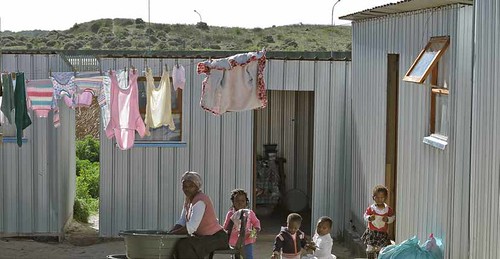
An influential debate is playing out in the proverbial halls of global development decision-making far from the informal settlements in African cities. The basic targets that will drive government decisions around spending and policy priorities, donor areas of focus, and wider perspectives aound development, are under discussion. These are targets that will promise much of what the post-World War II development institutions have long committed to the people who live in the so-called “developing world.” These are targets to “eliminate poverty,” “deliver basic services,” “secure growth” “reduce inequality,” and so on.
Civil society has very little voice in the determination of the next round of development goals, and this is even truer for the people who are the subjects of these promises. For the people who live in slums, who lack access to toilets, water, and economic security and opportunity, abstract commitments to change their conditions mean little.
Yet the content of the Sustainable Development Goals (SDGs), and the prospect of an urban goal, are significant for all of us who work to make cities more inclusive. Much work is to be done, especially to ensure that an urban goal – and indeed all goals – recognises the deep divides of power, finance, and knowledge that characterise the decisions that drive urban development. SDI is one of a number of organisations that is demanding that the urban poor — the current losers but surely the most worthy potential winners of such a debate — be located as central actors in the goals that governments and formal agencies adopt. For the urban poor federations in Africa, Asia, and Latin America, that comprise our network, development goals have to be about improving the lives of real people. As such, a goal on cities must be fundamentally oriented around the people who stand to gain — or lose — the most from the success or failure of such a goal.
A target for universal provision of well-located land, shelter,and basic services should be a minimum of an urban goal. Unfortunately, the previous Millennium Development Goals included a goal on slums that was very unclear and very unambitious – only 100 million were to be helped. The Millennium Development Goals also made the commitment to reduce by half those without adequate water and sanitation. An urban goal should encompass a specific focus on inclusion and the rights of the poor in cities through universal access to these amenities (land, services, and shelter).
Last year, SDI began to articulate a set of principles for a global compact on urban development, the Urban Poor DevelopmentGoals. There are four elements:
1. Inclusive Institution Building: State institutions reformed or created to embed partnerships with community organisations, especially at the city level to drive decision making about programmes and ensure adequate financial allocations.
2. Inclusive Land Managament: Well located land should be made available to the urban poor, who constitute the majority in most cities in the developing world. Zero forced evictions and security of tenure for slum dweller communities.
3. Inclusive Urban Infrastructure: Water, sanitation, electricity and transport infrastructure that services the poor so as to acheive zero open defecation in cities globally within 10 years and electrcity for all.
4. Inclusive Community Development: Programmatic investment by national and local authorities in capacity building of community organisations so as to realise the inclusive development agenda in the above three elements.
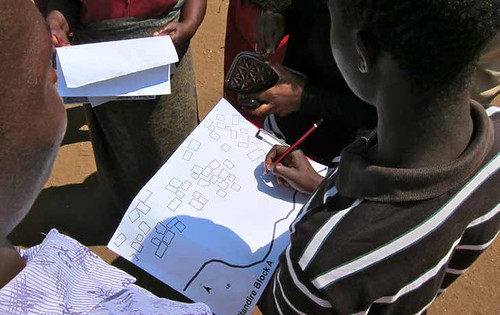
One of the biggest advantages of the emergence of strong support for an urban goal in the post-MDG framework is that it focuses policy-makers on a specific space and a scale of administration in which to make change. In particular, this means a much greater focus on both formal local government and the constellation of actors that drive local governance. Strong local government requires a strong and organised slum dweller organisations to drive both innovation and accountability in our cities.
We cannot ignore this debate because it will define our work for years to come. Now is the time to do what previous development agendas have conspicuously avoided doing: putting the voices and tools of the informal majority of our cities at the centre of how we work. This is the real promise of an urban goal in the SDGs.
Check out SDI’s 2013 – 2014 Annual Report for more on the Post MDG Debate
Jockin Arputham: From Slum Dweller to Nobel Peace Prize Nominee

‘Jockin-sir’, as Mumbai’s slum dwellers call him, is an inspirational figure helping India’s dispossessed stand up for their rights, find new homes, and plot a way out of urban poverty
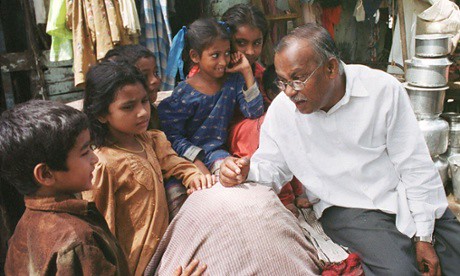
Jockin Arputham chats with children about school in the Madanpura slum in central Mumbai. Photograph: Reuters
**Cross-posted from The Guardian**
By Srinath Perur
Parveen Shaikh was born in a pavement dwelling of sacks and plastic sheets in Sewri, on the eastern edge of Mumbai. She married another pavement dweller from across the road. “Born on east side footpath, married on west side,” she jokes. When her first son was a little over a month old, the city’s bulldozers came to raze her home. The road was to be widened.“I was taking down the bamboo supports when Jockin-sir’s people came with a stay order,” she says.
“Jockin-sir” is what thousands of former and present slum and pavement dwellers in Mumbai call Jockin Arputham, the founder of the National Slum Dwellers Federation (NSDF) and president of Shack/Slum Dwellers International (SDI). In Mumbai and across the world, Arputham has long been an inspirational figure within an alliance of organisations helping slum and shack residents to stand up for their rights, find new homes, and plot a way out of urban poverty.
A woman named Kanta from the alliance – which also comprises Mahila Milan (Women Together in Hindi) and SPARC (Society for the Promotion of Area Resource Centres) – came to meet Parveen and her neighbours soon after the demolition was deferred. She wanted the women to participate in a savings scheme by contributing small amounts daily. Kanta was chased away with abuse, but she persisted in coming back and convinced the women to meet Arputham. They softened after meeting him a few times: “We wouldn’t bathe for days together, we’d smell, our hair would be wild. No one would come near us, but Jockin-sir would sit with us and eat.”
Previously the women, who mostly worked at construction sites or as household help, hadn’t been able to save because opening a bank account required proof of address and a guarantor. Squirrelling money away didn’t work, Parveen says, because many of the men around were alcoholics who’d “beat it out of us”. With the alliance’s savings scheme, the women were able to accumulate amounts that would help their families transition into replacement housing, with its bills and maintenance costs.
Six years ago, Parveen and her family moved into a room measuring 225 square feet with a toilet and a bathroom, obtained at no cost through the alliance. Now she works for the organisation, like Kanta, reaching out to women living in slums and on pavements. Her two sons are in middle school; the older wants to be an IAS (Indian Administrative Service) officer, the younger an automobile engineer, and they wish they had a larger house with rooms of their own. “I remind them every day that we came here from the footpath,” Parveen says.
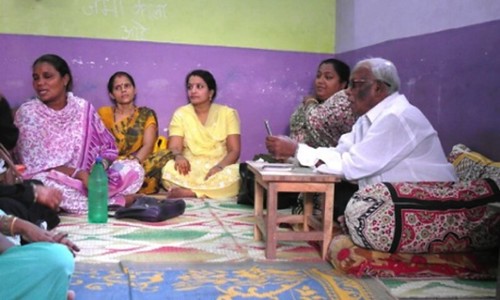
Jockin Arputham holds court. Photograph: Srinath Perur
Normally garrulous, she quietens as we walk down a street in Byculla, south Mumbai. The street is dense with pedestrians, scooters, cars and push-carts. The pavements are occupied by people selling clothes under once-colourful parasols. They used to have people living on them, but this stretch has now been cleared and its inhabitants resettled.
Further on, the pavements are packed with shacks built with plywood or sometimes bricks, divided into warrens by pieces of cloth and flimsy partitions. Their fronts are dominated by drums and buckets used to store water and clothes hanging on lines. Some shacks are double-storied, with a ladder leading upwards. On the corner where road meets pavement is a shared open drain with grey sludge, likely the source of the odour in the air. Parveen says it reminds her of how she used to live.
Why do people migrate to cities to live like this? Parveen – whose parents came from a village in rural Bihar before she was born – says if the government provided people with means of sustenance in their villages, they would happily live there. But they’re forced to move to cities where there is work, if not housing. Around 65 million Indians live in slums. And in Mumbai, India’s most populous city, around 60% of its 12 million people live in slums – defined by the Census of India as being “unfit for human habitation” for a multitude of reasons.
“I am a proud slum-dweller,” says Jockin Arputham, 67, sitting in his office on the ground floor of an eight-storey building in a redeveloped portion of the Dharavi slum. He has lived in slums for most of his adult life, working, first in Mumbai and then across the world, to organise slum residents and improve the quality of their lives. His work has won him the Magsaysay award in 2000 and, earlier this year, a nomination for the Nobel Peace Prize, put forward by the Swedish minister for public administration and housing, Stefan Attefall, and supported by ministers from Norway and South Africa.
“There is a war between the urban rich and the urban poor,” Arputham says. “And I’m trying to make peace between them.” According to him, the upper classes think of slum residents as lazy, criminal elements out to swindle the resources of the city. “It’s the opposite,” he says. “We are not impinging on resources. We don’t take much water, electricity, public transport. We are the human resource of the city.”
Sometimes, he says, an expensive car, its occupants rendered helpless by truant domestic help, will drive into a slum looking for them. “Their clothes aren’t being washed, their food isn’t being cooked. City life for the upper middle-class can’t survive without domestic help – and where do they come from?” There is no affordable accommodation for them in the city, he points out, causing them to live in slums. The land officially set aside for the homeless in Mumbai, Arputham says, is less than 6%, while the requirement, going by their number, should be closer to 60%. “And you blame slum dwellers for your poor planning.”
Those who live on the pavements have it even worse than slum dwellers, says Arputham. “You’re lying down with your wife on the footpath and car lights fall on you. What kind of society lives like this? We need to give dignity to human beings.”
Only a couple of decades ago, slum and pavement dwellers could be evicted summarily because they were seen as encroachers. Now, owing in large part to his efforts, policy recognises slum residents as valid inhabitants of the city, entitled to compensation and alternative housing.
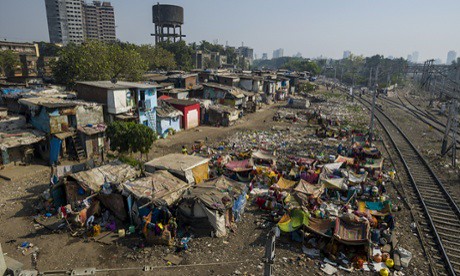
Some shacks in Dharavi slum have two storeys with a ladder to reach the top floor. Photograph: Image Broker/Rex
Arputham was born in Kolar Gold Fields, near Bangalore, in the south of India. He moved to Mumbai when he was 18 to work as a carpenter. Having no place to live in, he began sleeping outside people’s houses in Janata Colony, a slum of around 70,000 people in Mankhurd. There was daily wage work to be had at the nearby Bhabha Atomic Research Centre (BARC), where a new reactor was being constructed.
For two days, he worked as a sweeper, offering himself to contractors. Then, seeing that the contractors themselves didn’t need any credentials, he started a company called Lift and Shift and began hiring labour to clear garbage, clean the grounds and move machines. This made him relatively well off in the slum. He’d buy sweets and snacks for the children of the colony and ask them to sing for him, which turned into regular musical gatherings. At some of the parents’ urging, he began to run an informal night school where, since he hadn’t finished school himself, he got the older children to teach the younger ones.
The colony had no garbage collection, which led to a mosquito menace. The municipality had chosen to ignore the settlement, and Arputham took this on. He announced a picnic for which 3,000 children from the community turned up. Each of them was to bring along a bundle of garbage wrapped in a newspaper sheet. The picnic began early in the morning, and the long procession of children was led to the as-yet-unopened municipality office to dispose of their loads. He laughs and claps his hands at the memory: “In half an hour the whole compound was full of garbage.”
Later in the day, incensed officials and police came to the colony, and this ultimately led to the municipality beginning regular garbage collection. “That is the first day I tasted the power of community,” Arputham says. He went on to construct toilets, build paths, organise work camps, and soon found that he was a leader. Yet he never had a home of his own in the colony – he was taken care of by the community.
In 1970, when the colony received a notice that the land would be cleared for use by BARC, it was natural for Arputham to lead the opposition. “No eviction without alternative” became the slogan, and the movement for the first time united all 1,200 slums in Mumbai. He took the struggle to Delhi in 1975, met political leaders and sat in protest outside Parliament for 18 days before the prime minister Indira Gandhi granted him an audience. He mimics her looking at him from above her glasses like a stern headmistress: “What is your problem? Why are you doing this?”
Arputham told her, and returned to Mumbai with a written assurance that the colony would not be cleared. But the prime minister didn’t keep her promise. On 17 May 1976, Arputham was arrested. A force of 12,000 policemen stormed the colony and evacuated the 70,000 residents overnight to a swampy area four kilometres away (that turned into another, still extant, slum called Cheetah Camp). BARC would use the cleared land to house 3,000 employees.
Arputham had developed a brand of urban guerilla tactics that he recounts with impish glee: obtaining stay orders that would be shown to the police only at the last minute to cause them maximum inconvenience; dealing with delaying tactics of officials by sending groups of unwashed women whom they’d try to get rid of as quickly as possible; amassing crowds of thousands to paralyse the city; hiding from the police among crowds of women since he’s a small-built man, on some occasions even under their sarees.
“I used to stop Bombay city. I never used violence, but I taught people how to be a nuisance.” Records say Arputham was arrested more than 60 times. But this was mostly on paper, the police trying to obey instructions from above without risking another protest on the streets.
The struggle for Janata Colony united slum dwellers across India, and brought attention to their summary displacement as cities developed. In 1975, Arputham started the NSDF to protect the rights of slum and pavement dwellers. Over the next decade, court rulings and campaigns changed government policy so that India’s cities began to look at providing sanitation, power and water to slums, and replacement housing when slums had to be torn down. Organisations such as SPARC conducted surveys to come up with a cartography of urban poverty – how many people lived in slums, on pavements, by the railway tracks, how long they’d been living there, what basic amenities they had or lacked – that would be the first step towards rehabilitation.
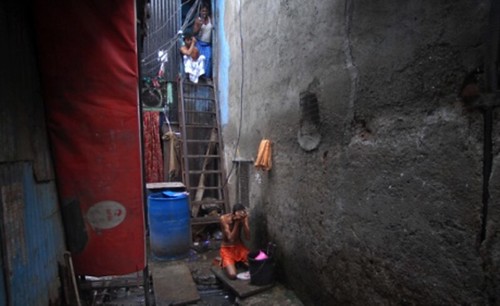
Daily life in Dharavi. Photograph: Divyakant Solanki/EPA
It’s mid-morning and Arputham is sitting outside an administrative office in a replacement housing unit called Natvar Parikh Compound in the eastern Mumbai suburb of Govandi. Around 7,000 families, including Parveen’s, live here in 56 eight-storey buildings. “From 1974 to 1990, the government said there was no land to house the poor,” he says. “We developed and demonstrated how non-government land could be used.”
The key was to identify land that had been allotted to institutions or to industries in less crowded times, but remained unused. This land in the city could be exchanged for a valuable commodity: the right to develop real estate towards the less-crowded north of the city. An acre of land given to the government for housing would earn the right to develop one acre of built-up area, an instrument that could then be traded in the open market. The compound we’re in is an example: 2.3 hectares of land allotted decades ago for industrial use, then traded for TDR (Transferable Development Rights) and converted into housing for the poor.
The buildings are seven storeys of housing plus a ground floor for shops and small businesses that provide employment to some of the people living here. Small units manufacture bangles, handkerchiefs, bags. One of the buildings’ common areas has a pile of litter; a resident who’s showing me around says, “People here have lived amidst garbage. It takes time to unlearn habits.”
The replacement ‘houses’ are really single rooms with a small toilet and bathroom, 225 square feet in all, provided free of cost to slum and pavement dwellers. These cannot be sold or rented out for 10 years. Among those living here, some are better off than others. Mumtaz Ansari’s room has eight people living in it, and has an air-cooler, fridge, TV, washing machine and two almirah cupboards. Another house in the same building has only a few utensils. In another, an old woman who can’t see appeals to me to convince her family to get her cataracts operated upon. Her daughter-in-law tells me they just got her a prosthetic leg – her left leg was amputated due to complications of diabetes – and they’re waiting till they can afford the cataract surgery, which after all is not essential.
Clearly, beating urban poverty is a precarious project which goes far beyond simply having a roof over one’s head. Over the years, the alliance has developed a set of practices and interventions to make the transition easier – many of which revolve around women’s leadership and participation. According to Arputham: “Women are smarter. They know everything about everyone in a settlement. And they are natural communicators.”
The small savings scheme, run entirely by women, helps develop preparedness for maintaining an establishment. The rooms are usually allotted in the names of women so they are less vulnerable to domestic abuse and familial instability. Care is taken to relocate slum residents within a couple of kilometres of their previous address so that work is not affected. A committee interfaces between residents and the police so both sides aren’t harassed. The alliance provides food rations, medicines and cash loans to residents when they have to tide over a difficult period.
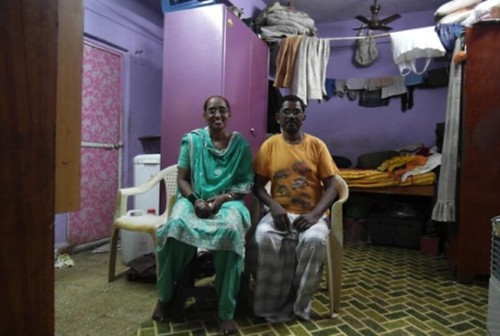
Mumtaz Ansari in the room she shares with seven others. Photograph: Srinath Perur
Arputham and the alliance encourage communities to work from within – which is why so many of its employees are current or former slum residents themselves. Parveen says: “If someone tip-top comes and says, ‘I’ll give you a house,’ the first thought that comes to mind is he’s making a fool of you. He’ll take photographs, sell them to foreigners, make his money and vanish. But if I go and say, ‘I’m your sister, I used to live on the footpath,’ they listen.”
Arputham says about working on behalf of the poor: “You can’t become another rich grabber, another competitor.” I ask if he saw the film Slumdog Millionaire. “Oh, no,” he exclaims and turns away in disgust. He was invited to a screening but soon walked out. “I couldn’t take it. You are exploiting the slum dweller.” Later, at an event, Prince Charles happened to introduce him to the film’s director, Danny Boyle. “I kicked that fellow,” he says (not meaning it literally).
The alliance runs a not-for-profit construction company to undertake slum improvement or rehabilitation projects. One is from the city for construction of toilets in slums: these are paid for by the city, but their construction and maintenance is supervised by women from the community. Most slum and pavement residents in Mumbai use common toilets, and when these are insufficient, go in open areas or by railway tracks. This, in addition to issues of hygiene, leaves residents, especially women, vulnerable to assault.
At BMC Colony, in the northern suburb of Goregaon, Arputham holds a meeting, sitting on the floor at a low table, women in front on him on mats. A new block of toilets with 45 seats has just been constructed here. “Toilets have become a symbol,” he says. “Now, ministers come to inaugurate them.”
Two women from a slum in Aarey Colony are visiting because they currently go in the open and would like a toilet. Beyond the usual reasons for wanting a toilet, the colony faces an added threat, unusual for a city – leopards. As the city presses upon the neighbouring Sanjay Gandhi National Park, leopards have begun entering settlements and have sometimes killed squatting humans, especially children, after mistaking them for prey. Arputham tells the two women how to petition the corporation, and asks them to stay in touch with the women here and learn from them.
“Unity and strength: that’s what my women are learning, that’s what they are teaching,” he says, with visible pride. So far, the alliance has relocated and rehabilitated around 37,000 families in Mumbai. Across India, their surveys have counted around 4 million families of the urban poor and made them visible to the system.
SDI was founded in 1995, with Arputham as its head, to link organisations dealing with urban poverty across Asia, Africa, Latin America and the Caribbean. SDI today spans 33 countries where 90% of the world’s slum population of 800 million people live. Earlier this year, it won the $1.25m Skoll Award for Social Entrepreneurship. Now, he and SDI have been proposed for the Nobel Peace Prize.
“All these awards I accept on behalf of the slum dwellers who were my university, my teachers,” Arputham says. “The money goes to the organisations. If I can give all the poorest of the poor a house, that will be my biggest victory.” In recent times, his poor health has slowed him down a little. Still, Parveen says they have to force him to rest: “He never seems to sleep. He just dreams with his eyes open.”
Know Your City: Discussing Community-Collected Data at World Urban Forum 7

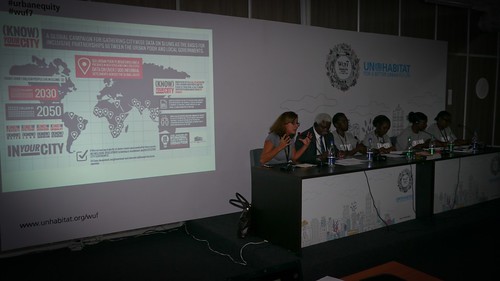
By Ariana MacPherson, SDI Secretariat
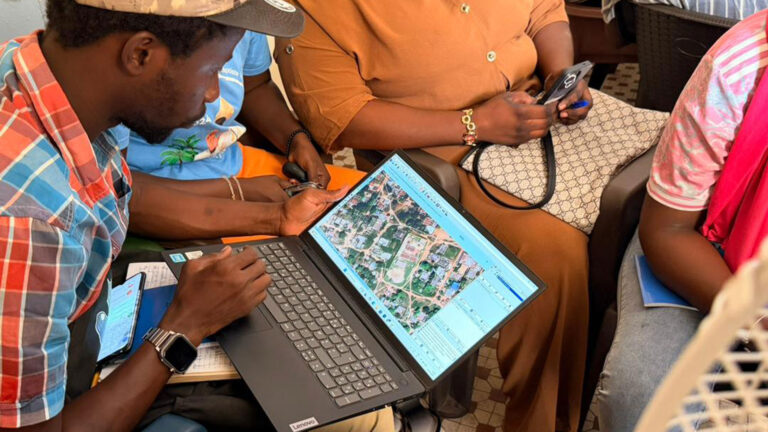
There has been a lot of discussion at this week’s World Urban Forum about the use of data as a key tool in the development of inclusive, sustainable cities. Key to this discussion is how data can be used in the cities of Africa, Asia and Latin America, most of which still face major challenges around urban poverty and whose city development strategies, for the most part, continue to exclude the large majority of these cities’ populations – the urban poor. But yesterday at SDI’s networking event, a strategically different approach to data was presented and discussed. The Know Your City campaign – a global campaign for gathering citywide data on slums as the basis for inclusive partnerships between the urban poor and their local governments – was presented as a critical component of the push for urban data. When communities of the urban poor collect data about their own communities, in partnership with their local and national governments, they are armed with the necessary tools to become key players in the development of strategies of urban development that take into account the realities and needs of the city’s urban poor majority.
In our networking event, delegates from SDI-affiliated urban poor federations and support NGOs, the SDI Secretariat, and key international networks and agencies discussed the importance of this campaign in greater detail. Jack Makau of the SDI Secretariat spoke on the history of SDI’s data collection strategies. SDI-affiliated federations of the urban poor have been collecting information about themselves for decades. This data has led to upgrading projects in affiliates across Africa, Asia and Latin America, and has formed the basis of large-scale slum upgrading interventions in India, South Africa, Zimbabwe, Kenya and more recently, Uganda.
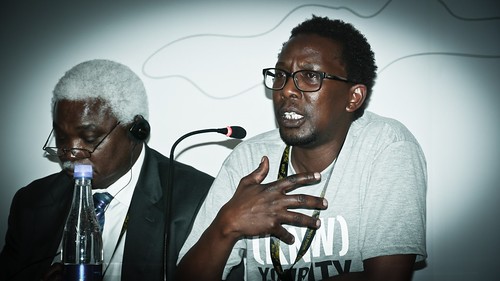
In the last year, however, the SDI network has begun to standardize and aggregate this data in a way that we have not been able to before. This means that urban poor communities have expanded their scope – from collecting data only about the settlements where they live, to collecting data on all the slum settlements in their cities. This includes demographic, spatial and economic information that allows for a picture of the whole city – data that can be used to drive communities’ negotiations with local government for slum upgrading and development at the citywide scale. The accuracy and ownership of the data is enhanced because it is collected and used by communities in discussions with city governments on upgrading plans and programs, meaning that the communities themselves have a greater stake in the need for accurate, up-to-date information.
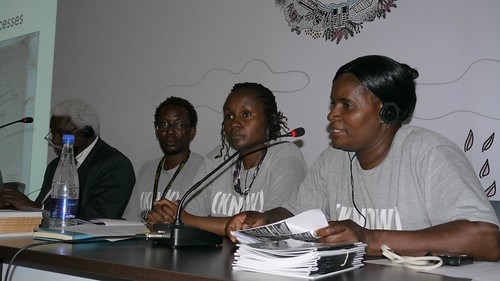
These claims were supported by the experiences of SDI affiliates from Kenya and Zimbabwe. Catherine Sekai, national leader of the Zimbabwe Homeless People’s Federation, related that the Federation, alongside their local authority, “profiled the entire city of Harare, settlement by settlement” to identify peoples’ needs on the ground. This led to the transfer of land by the city to the communities for the construction of upgraded houses in Dzivaresekwa Extension, one of Harare’s largest slums.

Another example of the power of community-collected data came from Irene Karanja, executive director of Muungano Support Trust, support NGO to the Kenyan urban poor federation Muungano wa Wanavijiji. Karanja shared some key findings from 300 community-driven profiles from slums in 20 cities and towns across Kenya. Two central issues emerged from these profiles: land and sanitation. Most of the land occupied by slums in Kenya is privatized, and currently under high threat of eviction from developers looking to take back the land as land values in Kenya’s cities continue to rise. Because of the status of land ownership, interventions around sanitation have been nearly impossible and continue to threaten health and security of slum residents, particularly women.
Karanja concluded her presentation by calling to action the Kenyan government and global urban development stakeholders, stating that, “The dialogue [around urban development] has to change now as we move towards Habitat III – poor people need a chance to expose the data that we are talking about today. Communities have data that government does not have. Despite this, government does not want to accept this data. It is our hope that this data can be used in Kenya to form part of the national urban agenda.”
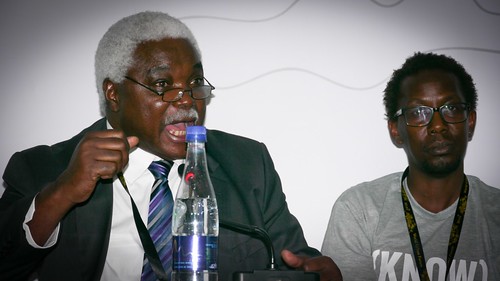
Two of SDI’s key institutional partners in the Know Your City campaign also participated in the event – Jean Pierre Elong-Mbassi, Secretary General of United Cities & Local Governments Africa (UCLG-A) and Anaclaudia Rossbach, Regional Advisor to Latin America and the Caribbean from Cities Alliance. Elong-Mbassi reminded the group that at least 50% of Africa’s cities are made up of slums, and that “any mayor interested in managing a city in a comprehensive way cannot ignore slum dwellers.” Elong-Mbassi echoed the call to action of the Know Your City campaign, requesting that local governments “leave [behind] the moment where we use second-hand data to [understand] reality,” instead, he went on to say, “We want first-hand data from communities to be the mine of knowledge for the management of cities.”
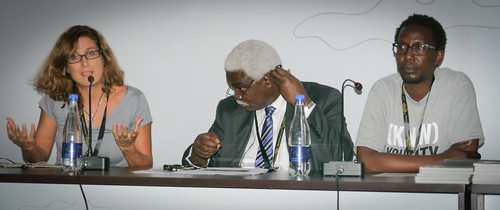
Lastly, Anaclaudia Rossbach of Cities Alliance, coming from her experience in municipal government and her background as an economist, went on to endorse the need for community-collected slum data as critical to the successful implementation of slum upgrading projects. Indeed, with SDI sitting as a member of the Cities Alliance Executive Committee, the Know Your City campaign is part of the Cities Alliance medium term agenda. Rossbach emphasized the key point that it is only feasible to collect accurate data if the local people take ownership of the process – a critical component of SDI’s data-collection strategies.
SDI Launches Know Your City Campaign at World Urban Forum 7

SDI is getting ready for the seventh World Urban Forum (WUF) to be held in Medellin, Colombia from 5 – 11 April 2014.
As the largest and most widely attended conference on cities, World Urban Forum presents an excellent opportunity for SDI affiliates to present their work at the global scale, and network with key urban stakeholders – local and national governments, city officials, community organisations, international development organisations, academia, and more – in order to catalyse work on the ground.
SDI will host a booth in the Exhibition Hall of the Plaza Mayor, where visitors are welcome to drop by to learn about our activities and catch up with delegations from SDI affiliates.
This year, SDI will focus its WUF activities on our Know Your City Campaign, aimed at the development of protocols for cities to map slums across the city. Every household, every neighborhood and every informal settlement has to be counted. There can be no inclusive or equitable development planning and investment, nor effective city governance if the increasing majority of the residents of informal settlements remain unaccounted for. The campaign will be officially launched at our networking event, “Know Your City: Creating Resilient and Equitable Cities through Partnerships for Community-Collected Data,” on Tuesday 8 April at 16:30 in the Yellow Pavilion, Room 11.
SDI has demonstrated that cities have to work with urban poor communities to collect baseline data and maps of all informal settlements in the city. This is the beginning of forming a relationship with those who have remained invisible in city planning in the past.
Our campaign seeks to invite communities of the urban poor, NGOs, academics, and city mayors and administrators to join this campaign. We urge national governments, bilateral agencies, multilateral organizations, and academics, to finance and support this process.
SDI’s experience shows that slum mapping has many immediate and long-term benefits.
Firstly, it helps settlements to develop a collective understanding. When communities visit each other while collecting information, settlements begin to network. Most of SDI federations have emerged through such exercises.
Secondly, sustainable development for cities needs to makes sure that information about all living in the city has to be collected, and updated. Invariably, cities list only half the settlements. This leads to skewed investments; increased difference between amenities and services provision and more difficulty in catching up to provide all these services.
Thirdly, in times of increased awareness of city responsibility to vulnerability with man-made and climatic disasters, reaching those most vulnerable and often least documented is always a problem for city administrations.
Helping the poor to create a voice, a collective identity, and possibilities to participate in transformation and change is an integral aspect of what we all seek in the future of cities.
A list of the events SDI is hosting and participating in is provided below. In addition, you can download our official WUF schedule and programme of events here.
–
List of SDI Events at WUF 7:
Monday 7 April
10:00 – 11:30
“Putting Poor People at the Centre of Strategies for Urban Development,” (Next City and SDI)
Speakers: Patrick Maghebula (South Africa), Irene Karanja and Joseph Muturi (Kenya), Sarah Nandudu (Uganda)
Venue: USA Pavilion, Innovative Americas Booth
Tuesday 8 April
8:00 – 11:30
Civil Society Roundtable
Speakers: Rose Molokoane (South Africa), other speakers TBC
Venue: TBC
12:15 – 13:15
“The Know Your City Project: Building Inclusive Cities through Partnerships beteween Local Government and Slum Dwellers in Zambia and Burkina Faso,” (UCLG-A and SDI)
Speakers: SDI: Regina Chikoka and Nelson Ncube (Zambia); Other: Jean-Pierre Elong Mbassi (UCLGA), Hon. Daniel Chisenga (Mayor of Lusaka), Lusaka City Council Member (TBC); Moderator: Charlton Ziervogel (South Africa)
Venue: City Changer Room
14:00 – 16:00
“How to Enable Urban Innovation – Fast, at broad scale, and equitable?,” (Ministry of Economic Development, Germany)
Speakers: Farouk Braimah (Ghana), other speakers TBC
Venue: Red Pavilion, Room 16
“Gender, Asset Building, and Just Cities,” (The Ford Foundation)
Speakers: SDI: Beth Chitekwe-Biti (Zimbabwe); Other: Sonia Dias (WIEGO), Huraera Jabeen (BRAC), Cath McIlwaine (Queen Mary’s University of London), Caren Levy (DPU London); Moderator: Caroline Moser (Ford Foundation)
Venue: Yellow Pavilion, Room 6
“Leaving No One Behind: How can we better monitor progress in ‘slum’ areas?” (Overseas Development Institute)
Speakers: Joseph Muturi (Kenay), other speakers TBC
Venue: Red Pavilion, Room 23
16:30 – 18:30
“Know Your City: Creating Resilient and Equitable Cities through Partnerships for Community-Collected Data,” (SDI)
Speakers: SDI: Catherine Sekai (Zimbabwe), Jack Makau, and Irene Karanja (Kenya); Other: Anaclaudia Rossbach (Cities Alliance), Jean-Pierre Elong Mbassi (UCLG-A); Moderator: Rose Molokoane (South Africa)
Venue: Yellow Pavilion, Room 11
“Scaling Up Informal Settlement Upgrading & Prevention through National Housing Policies and Programmatic Approaches: Lessons Learned from 12 Countries,” (Ministry of Works and Housing of Ghana)
Speakers: Farouk Braimah (Ghana), other speakers TBC
Venue: Red Pavilion, Room 22
Wednesday 9 April
14:00 – 16:00
“Towards a New Urban Paradigm: The Future We Want, The City We Need,” (World Urban Campaign Special Session)
Speakers: SDI: Rose Molokoane (South Africa); Other: Joan Clos (UN Habitat), Nicholas You (WUC), Eugene Birch (WUC), Bert Smolders (ARCADIS & UPP), Shipra Narang Suri (ISOCARP), Janice Peterson (Huairou Commission), Lorenzo Casullo (Youth Advisory Board), Jean-Paul Huchon (FMDV), UCLG Representative (TBC), Anibel Gaviria Correa (Mayor of Medellin), Peter Gotz (Global Parlimentarians on Habitat)
Venue: Gran Salon, Room G5, Plaza Mayor
“Planning Differently: Community Based Slum Upgrading Studios,” (Association of African Planning Schools and SDI)
Speakers: SDI: Beth Chitekwe-Biti (Zimbabwe), Rosalinda Hendricks (Namibia); Other: Nancy Odendaal (AAPS), Hon. James Chiyangwa (City of Harare); Moderator: Jack Makau (SDI)
Venue: Yellow Pavilion, Room 12
“Future of Places: Public Spaces in Favelas and Slums,” (Future of Places and SDI)
Speakers: SDI: Farouk Braimah (Ghana), Maria Eugenia Torrico (Bolivia); Other: Hon. Ibrahim Baidoo (Mayor of Ashaiman, Ghana), Elin Andersdotter Fabre (Ax:son Johnson Foundation), Mary Jane Ortega (ICLEI), Andres Borthagaray (City on the Move Institute)
Venue: City Changer Room B
“Citywide Slum Upgrading Programs: Taking stock of practices, outcomes, and innovations in scaled-up approaches to integrate slums into the formal city,” (FAU / UFRJ)
Speakers: Muhammed Lutwamma and Edris Lubega (Uganda), other speakers TBC
Venue: Red Pavilion, Room 17
Thursday 10 April
8:30 – 11:30
“Basic Services: Local Businesses for Equitable Cities,” (WUF Dialogue 3)
Speakers: SDI: Patrick Maghebula (South Africa); Other: Juan Esteban Calle Restrepo (Public Enterprises Medellin), Didas Massaburi (Mayor of Dar es Salaam), Joachim Prey (GIZ), Mahendra Subba (Ministry of Urban Development, Nepal), Sarah Rosen Wartell (Urban Institute); Moderator: Mathieu Lefevre (New Cities Foundation)
Venue: TBC
“The Politics of Sanitation: Strategies to Achieve Scale,” (International Institute for Environment & Development and SDI)
Speakers: Beth Chitekwe-Biti, Catherine Sekai, and Sheila Magara (Zimbabwe); Nelson Ncube, Regina Chikoka, and Joyce Lungu (Zambia); Tim Ndezi, Khadija Kigi, and Felistas Komba (Tanzania); Cynthia Phiri and Mphatso Njunga (Malawi); Moderator: Diana Mitlin (IIED)
Venue: Red Pavilion, Room 17
“Strong Local Government for Development through Partnerships in Ghana, South Africa & Uganda,” (UNDP and SDI)
Speakers: SDI: Rose Molokoane (South Africa), Muhammed Lutwamma (Uganda), Farouk Braimah (Ghana); Other: Magdy Martinez-Soliman, (UNDP), Patrick Keuleers, (UNDP), Hon. Ibrahim Baidoo (Mayor of Ashaiman, Ghana), Mr. Kibuuka Patrick Musoke (Kampala Capital City Authority, Uganda); Moderator: Kodjo Mensah-Abrampa, (UNDP)
Venue: One UN Room
“How Can STDM & Technological Tools Support Community Development, Dialogue & Participatory Mapping?” (Habitat for Humanity International)
Speakers: SDI: Jack Makau (Kenya), Sonia Fadrigo (Philippines), Sarah Nadudu (Uganda); Other: Brenda Perez Castro (Habitat for Humanity Colombia), Escarlem Rodriguez (Bolivia), Somsook Boonyabancha (Asian Coalition for Housing Rights)
Venue: Red Pavilion, Room 15
13:00 – 14:00
“Informal Settlement Profiling – A first step in developing slum upgrading plans: The Zimbabwean case,” (Penn Institute for Urban Research)
Speakers: Beth Chitekwe-Biti (Zimbabwe)
Venue: Penn IUR Exhibition Stand (30)
14:00 – 16:00
Habitat University Initiative Universities Roundtable
Speakers: SDI: Irene Karanja (Kenya); Other: Sahar Attia (Cairo University), Mario R. Delos Reyes (Univ. of Philippies), Ana Falu (National University of Argentina), Shuaib Lwasa (Makerere University, Uganda), Michelle Mycoo (Univ. of West Indies), Hans Skotte (Norwegian University of Science & Technology), Bruce Shiftel (Georgia Institute of Technology); Moderator: Michael Cohen (The New School, New York City)
Venue: TBC
17:00 – 18:30
“Citizens & the City Working Together,” (Cities Alliance with SDI & WIEGO)
Speakers: Sonia Fadrigo (Philippines), Catherine Sekai (Zimbabwe), Edriss Lubega (Uganda)
Venue: Cities Alliance Exhibition Stand (76)
Friday 11 April
14:00 – 16:00
“Smart Cities from the Bottom Up,” (Santa Fe Institute and SDI)
Speakers: SDI: Marlene Don and Charlton Ziervogel (South Africa), Edriss Lubega (Uganda); Other: Luis Bettencourt (Santa Fe Institute); Moderator: Beth Chitekwe-Biti (Zimbabwe)
Venue: Red Pavilion, Room 22
SDI Attends Launch of World Urban Campaign’s “The City We Need”
While cities are increasingly central to global development agendas, the precise strategies of city development remain contested. In almost all cities in Africa and Asia, the allocation of resources and political will towards provision of land, services, and shelter for the poor is woefully inadequate. Dominant methods of delivery through “public-private partnerships” and centrally planned strategies have made little impact on the lives of the poor. SDI has inserted a clear voice into this debate to build the voice of the poor to influence more inclusive city development processes.
On 4 March 2014 at Ford Foundation’s headquarters in New York was the official launch of The City We Need, a key event leading up to the 7th World Urban Forum to be held in Medellin, Colombia this April. The City We Need is a multi-stakeholder, collective contribution to the urban agenda created by World Urban Campaign partners, which have been engaging the international community, public, private, and civil society actors.
Last year SDI officially joined the World Urban Campaign – a lobby and advocacy platform on sustainable urbanization coordinated by UN-Habitat. The World Urban Campaign brings together various urban development stakeholders in an advocacy and partnership platform to dialogue, learn, and share solutions to create a new urban agenda for the Habitat III conference.
SDI President Jockin Arputham and Rose Molokoane, SDI Coordinator from South Africa, participated in the launch event and emphasized the importance of creating partnerships between government and the urban poor to find solutions to sustainable urban development. To create solutions, one must “Know Your City,” the name of the SDI campaign that aims to address the lack of data on informal settlements. There can be no inclusive or equitable development planning and investment, nor effective city governance if the majority of the residents of informal settlements remain unaccounted for. SDI has demonstrated that cities have to work with urban poor communities to collect baseline data and maps of all informal settlements in the city. Helping the poor to create a voice, a collective identity, and possibilities to participate in transformation and change is an integral aspect of what we all seek in the future of cities.
SDI will be participating in the World Urban Campaign Special Session at the World Urban Forum in Medellin, Colombia on Wednesday, 9 April at 2:00pm. This event will bring members of the World Urban Campaign together to discuss the new urban paradigm following the theme: The Future We Want, The City We Need. This event constitutes an opportunity to focus new partners around a common objective in order to create concrete goals for the achievement of sustainable urbanization and to mobilize in preparation for Habitat III.
Click here to read the full report of The City We Need launch event.
Cities Alliance Voices Support for SDI Nobel Peace Prize Nomination
SDI is pleased to share the below letter of support from Billy Cobbett, Director of Cities Alliance, for SDI’s nomination for the 2014 Nobel Peace Prize. Included is a link to the press release issued by Shelter Norway reporting the nomination.
Dear Consultative Group Members and CA Partners,
I am really delighted to write to you today and to draw your attention to the nomination of Cities Alliance member Jockin Arputham and Shack/Slum Dwellers International (SDI) for the Nobel Peace Prize 2014 (http://www.citiesalliance.org/node/4617). SDI is currently a member of the Executive Committee of the Cities Alliance.
SDI has been associated with the Cities Alliance since it was launched in 1999, increasingly influencing our common agenda. Cities Alliance members were delighted when SDI decided to join the partnership and became a formal member in 2008. Working through its’ affiliates, SDI has subsequently become a key implementing partner – for example in our Country programmes – and globally, as a powerful advocacy partner. In the latter role, SDI has played a critical and positive role in re-shaping the global debate around slums and slum-dwellers, demonstrating that they are not only an essential part of the solution, but also the originators of practical and innovative solutions. SDI forces governments – Mayors, Ministers, and Presidents – as well as multi-lateral and bi-lateral organizations to recognize slum dwellers as citizens, neighbours – and future Mayors. It is also worth recording that the majority of SDI members are women, a powerful fact also represented in its local, national and global leadership profiles.
SDI has certainly had a huge influence inside the Cities Alliance and, I am sure, within each of your organisations. The very fact of this nomination is an extremely powerful recognition for SDI’s impact, and very good news for all CA members and partners working for more inclusive, equitable and productive cities. We welcome the fact that SDI was nominated by the Swedish Minister for Public Administration and Housing Stefan Attefall, and also welcome the important political support from Norway and South Africa, all active CA members.
In particular, the Cities Alliance welcomes the recognition of the tireless work of SDI President Jockin Arputham, previous recipient of the prestigious Magsaysay Award, and an inspiration to all who have benefited not only from his intelligence and leadership, but equally from his infectious enthusiasm and optimism.
On behalf of the Cities Alliance and its members, we extend our warmest congratulations to Jockin and all SDI members. You have done us all a service in providing such an effective voice for slum-dwellers all over the world. I also call on all CA members to consider how they can add their weight to this important and very welcome nomination.
Sincerely,
Billy