Memoirs of a Ugandan Slum Dweller: Part IV


**Cross-posted from The Age of Zinc**
Age of Zinc is proud to present the fourth instalment in a new memoir from the slums of Kampala, Uganda. Check back every week to catch the next part of the story!
–
There were a lot of challenges growing up. When we were evicted from the house in the government quarters we had no place to go. We slept under a tree with no shelter for about one month. We just used bags and cloths to cover us, but no real shelter. We then found a community toilet that was not being used, so we just moved into the toilet and made it into our house. There were five of us that stayed there. We removed the rooms from both the men and women’s sides to make room for ourselves to sleep.
The community wanted to evict us because they said it is not normal for people to live in a structure that is a toilet. We explained to them that at the moment we didn’t have any other alternative and it was better then staying under a tree. Staying in a toilet was a better alternative because we at least had shelter. The mosquitoes could not reach us and the animals could not come near us, so at least we were safe.
We stayed in the toilet for about two years. It was really embarrassing to live there, but we needed somewhere to stay and survive. After some time, a family member from our clan came and said you can’t stay in this situation and gave us a kitchen (a small shack near the main house) to live in. It was in the same area in Naguru. We stayed there in the kitchen for some time. After one of my big brothers heard we were suffering he decided to buy the stall for our mother so we could stay there. I soon decided to leave and go to Kamwoyka because it was closer to my school.
Memoirs of a Ugandan Slum Dweller: Part III


**Cross-posted from The Age of Zinc**
Age of Zinc is proud to present the third instalment in a new memoir from the slums of Kampala, Uganda. Check back every week to catch the next part of the story!
–
When I was 15 years old I decided to look for ways to survive with my mother. So I started to sell milk and bread to earn some money. I would go to the milk factory, buy some milk and bread and then sell them to get a little money for my school fees. This way I could at least help her out with the younger brothers. She was a single mother at that time looking after all of us – six of us – and taking care of us. I decided that I should also start to work. I just felt I had to work, so I was working while also going to school.
I decided to talk to some girls about this small business of selling milk and bread and they liked the idea. We all agreed and formed a group. There were five of us. So we started buying and selling milk and bread. It was a good business because we could pay our school fees and also save a little money. We had to travel far distances and sometimes we would move at night and the places were not safe. We were selling at night, which was also dangerous, so you could not be alone; you needed someone who could move with you. We would leave very early at around five in the morning to go and buy bread from the bakery, which was in a different area, and then from the bakery go to the dairy corporation in Namuwongo in Kampala.
It was quite far between the two different areas, from Ntinda to Namuwongo, so we had to team up. One girl would wake all of us up in the morning and we would leave to go and buy the bread and then travel to buy the milk. Once we bought our commodities we would keep it while we went off to school. After school in the evening, we would come back and sell it. If we sold off everything we purchased in the morning we would go back to the factory around seven in the evening to get some more milk. We could sell up until ten in the evening. The balance we made we would hold onto and use for start up costs the next morning.
I had to do housework because I was the eldest but I also had to sell to make some money. I would go to sleep at around midnight and wake up at four in the morning. That was my resting time. I did my schoolwork at school. At school, I concentrated very hard in class and was a good student. I also did many school activities. When you’re active in school there was a way in which the school could give you some [monetary] assistance. So I was engaged in many things. I was a good long distance runner, I was a good music dancer and drummer, and I was a good actor. Whenever the headmaster would move around, I was there! Whenever we would win, I was a part of that team! Being active in school also helped me.
I also had no time to rest because I was trying to enjoy everything. I was not feeling a lot of stress because I was young and not thinking about so many things. It was not about the money, but to see how I could help my mother not to suffer. How I could work with her to see that we all survive.
Our neighbor was working in a bank and her children were all in boarding schools, good schools. I would always ask her to take me to the school but she could not afford to look after me as well. Then one day I happened to asked her: “let me fetch water for you and you could give me a little money that will help me pay my school fees.” She said it would not be enough, but I told her I would save and keep it because then at least I had something to start with. I was in form 1 in secondary school at the time. When she gave me money for fetching water, I used it to purchase one loaf of bread and two liters of milk. By the end of the day I had three loaves of bread and five liters of milk. That is how I started my business to earn money to pay for my school fees. Being able to earn money made me feel like I was in my own world, I was a free person.
Memoirs of a Ugandan Slum Dweller: Part II

**Cross-posted from The Age of Zinc**
I was born in the central part of Uganda in Bweyogerere, which is in Wakiso district outside of Kampala. I grew up in Naguru, which is in Nakawa Municipality. I grew up with my mother and father but when I turned ten my mother separated from my father. My father was working on long distance business so most of my time I spent with my mother.
My father was working with the Uganda Post Office, working at the post plant that is located in Bweyogerere, but moving around a lot to different areas. I knew him well, he used to come back and then we would be together. He was providing for us because he had a good salary. But he then went bankrupt after being falsely arrested when a generator was stolen from his workplace. He spent time in Luzira Prison until the real thief was discovered. The incident took a heavy toll on my family. My father, who had also been a storekeeper and bookkeeper, took to farming when he was released from prison and found it difficult to make a living.
I have two brothers and one sister – we are four. I’m the first of the four children of my father and fourth of the twelve children of my mother. I grew up with very many siblings but my first three siblings we are from different fathers so they stayed at their own father’s home. When my mother separated from my father, I stayed with a total of six.
Where I was born is not a slum but a semi rural area. But when I was growing up, after the separation, we moved around and at one time lived in government quarters. After a period of time we were evicted and went to the slum areas in Naguru Go Down, which is also in Nakawa. We lived here for some time. When I grew up I got married in the slum of Kamwoyka. I’ve lived in Kamwoyka for 17 years now.
In the settlement there are many different people. Some people are civil workers who could go and work to help their families. Initially my mother was working with the Ministry of Sports but because she had a lot of responsibility with all of us children she could no longer work. So she started her own business – she’s a market vendor in Nakawa. When she started, she couldn’t support us much because she was just learning the business. She was cut off (from the civil sector) so she had to look for a solution for herself. She had to find out how she can survive.
Memoirs of a Ugandan Slum Dweller: Part I


**Cross-posted from The Age of Zinc**
I never wanted to suffer like my mother had suffered.
Life in the slums is hard, especially when your parents are poor. There are so many people in these communities and being together with those your same age you find that the groups can influence your decisions. Seeing people with different things you would also like you try to see how to get what they have. This can change your mindset and girls start to go for men when they are still young – that is the main challenge.
Slums are open places so anyone can enter from anywhere and at anytime and there are so many different corners. So when children are moving someone can easily pull the child in and use the child. It happens in many areas, but sometimes it is kept secret. The child may be going to fetch water and someone will grab them. They put the child in the house and rape them and then let them go after threatening them not to tell anyone. They can be young, like 5 or 6 years old. You may not see the child for 3 days and by then the evidence is washed away. But you can tell something has happened. For instance they are walking funny. It’s rare a child will tell you so you just have to take note of your child and see how they are acting. In slums you find that boys always use the girls. Girl’s lives are spoiled at an early age. You find young single mothers suffering with their mothers. The mother is a single mother and her mother is also a single mother with many children. It becomes a hard life. I would say that I was lucky; I didn’t look for problems early. At least my mind was targeting at the right time and I was focused on getting my education not men.
Memoirs of a South African Slum Dweller: Chapters I – III
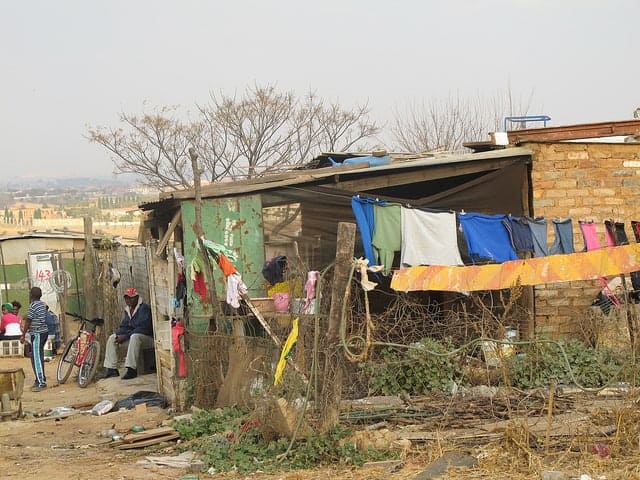

**Cross-posted from The Age of Zinc**
Chapter 1
When I arrived at P in 1982 I found myself amongst some of the very poor in our communities. I was lying on my back on a mattress covered with a plastic material so as to protect the mattress from the blood from bruises and wounds inflicted on me by my attackers in Newlands East in Durban. I was in pain, hurt, bruised, scared, and confused. I did not know this part of the city.
I had lived in the bush at a younger age and then I was frightened by snakes, wild animals and hunger. Here I was in one of the most notorious settlements in Inanda in Durban. I was scared of (izigebhengu) crooks, thieves, warlords, shack bosses and hunger.
I was put in a shack in a sector of the community now known as E. My neighbors never saw me arrive. They were busy drinking and dancing the night away. The person who organized me this shack was the mother of my eldest child who had come to my rescue that night when I was together with my friends being attacked. At the time our relationship was not serious and we had not yet had a child.
She had organized this shack for me and hid me there. Because she was the only person who knew where I lived in Inanda she would bring me groceries and cigarettes, which she collected from my aunt. At least once a week she made her way by taxi to Newlands and exploited my aunty’s generous nature for my benefit.
In those first three weeks I lived like an animal that sleeps during the day and hunts at night. I used to piss in a bucket and go out to shit at night. Eventually I got to know some people, which was just as well since my stocks from my aunt were no more coming. So I had to make friends. Because of the survival experiences I had picked up at boarding school and reformatory, it was easy for me to adapt to this jungle.
Oh there were many types of human animals here. The conmen, thieves, murderers, shebeen kings and queens, self-appointed head men, self-imposed “councilors” – those con political leaders of that time. And we thought we got rid of them forever when we chased them out of the townships in the 1980’s!
This place was a challenge to my young mind. In my life I had only known gang bosses, headmen and indunas, prefects and bullies. Here it was just the same – probably worse. And I had to survive. I started by trying to know the who’s who of the area.
I soon found out that the different residents of this area called P were actually normal people who were all trying to make a living. There were shebeens, brothels, gambling dens, and stokvels in a manner of speaking — not the one where money is saved and shared but ones where the trade was in people’s emotions and passions: people used to out-buy, out-dance, out-drink, take one another’s wife or husband. Out-eat, out-drink, out-dance, out-play the whole weekend. The place was a hive of activity.
I quickly became known because I was someone who could talk almost every subject and besides I could be very convincing because I was an honest liar. I always wanted to find a peaceful outcome, to help people with my jokes and my stories to find agreement with their friends who have betrayed them, with their enemies, their victims or their tormentors. This is a cruel world and one has to have cunning. My cunning was to make everybody laugh and even for a moment forget their anger or their jealousy, their sadness and even their pride. The ground is uneven and life will always be uneven and unequal. Sometimes the one who feels too deeply hides his anger, his hurt, his fear, in the costume of the clown.
I was in demand all over the settlement. Whether it was a party or feast or a simple indaba, the elders and people of the settlement always wanted me there. I also was a very respecting person. I could listen very attentively without blinking an eye … often because I was bored fast asleep.
I lived like this for some time until one day S, my girlfriend, told me she was pregnant. That was when I saw my life change.
She also changed. She became moody, stingy, jealous, curious, and suspicious all the time. I don’t know how many times I slept outside. Sleeping outside in a Durban Mjondolo in the mid 1980s was not a very safe thing to do. I don’t know how many times I got attacked by self-imposed community law enforcers. It could have been a lot worse.
It was at this time I started thinking about doing something else. You see by this time my relatives had forgotten about me. I had broken contact with them because my lady used to provide everything for me. Clothes to wear, from underpants to socks, cigarettes, alcohol, sex and false dreams. When she got pregnant she suddenly realized that I was not what I think she wanted. Every time we had an argument or disagreement she would publicly embarrass me by telling the community that even the smile on my face she had purchased from the local supermarket.
When the child was born she embarrassed me by telling people the truth: that I could not even buy napkins and baby food. She would sometimes even leave the child with me for days so that I would have to scrounge around for something.
One day I asked one of my neighbours to look after my son so I could try and get him some food. When I came back in the afternoon to my shock and horror, my child was in King Edward Hospital because the granny who had cared for him during the day ran out of milk and fed him moonshine. The child almost died. He survived and today does chemical engineering. Maybe it has something to do with the moonshine.
Of course going to the police at that time in history was like a sin. I almost killed her. That’s the justice of the slums. But my days in a Catholic Boarding school had the desired effect. Like I always do in tough times I decided to pray first and ask God to give me the strength to kill her. But God is unpredictable and instead of giving me power he asked me to forgive her. She can thank her lucky stars I listened.
Then one day a friend of mine, by the name of F gave me a ten rand because he heard that he and I were from the same rural area in Zululand. He told me to buy something to eat. Instead I bought a box of apples and a packet of oranges and began selling fruit. After a week of this I began seeing money. By the end of the month I had a full mini-market with potatoes, tomatoes, onions, and all the different fruit you can think of.
After about six months people were calling me “boetie” and “baas” because I could now lend people money, I could give people food to put on the table, I could now afford to take care of my son. I could now buy any shoes and socks I wanted. But still S decided to take the child and I did not see him again for almost ten years.
In the meantime I was making progress. I could now take decisions. I could now make suggestions. You know what I mean?

Chapter 2: The Beginning of Life, KwaZulu Natal
The portion of land I once called home still exists on a farm in the hills of Melmoth in the heart of Kwazulu. The three graves in the middle of the land are the little evidence that my family once lived here.
My great grandfather, I am told, was given this piece of land as compensation for his work in the British army, deployed to South Africa to fight the Boers in the Anglo-Boer War. He was an army officer by the surname of H. He settled on this land and married an African woman, never an uncommon event in South Africa history except for the years of National Party rule from 1948 to 1994, when these natural attractions were declared against the law. The Zulu woman who married my English great grandfather gave birth to a son, my grandfather, who in turn also married an African woman. These women, I believe, were all traditional healers from different clans in Kwazulu.
My father C H was the eldest son of H H who was also the eldest of his father’s sons and I am also the eldest of my siblings. If the men in my family were a mix of racial genes, the women in my family were “100 percent Zulu girls.”
If you follow the trend of intermarriage between white and African, and coloured and African in my family, you may be tempted to believe that by the time I was born in 1958, I was already diluted so much that I barely resembled my grandmother and my mother uMariam Khumalo who was born in Enkhandla in the 1940s.
I grew up there on this farm and we all lived there together and like all rural African children the houses of almost all my uncles and aunts became my home, not just my parental home.
My mother’s family KwaKhumalo believed I was theirs and they named me Jabulani Khumalo. My father’s family named me P. Also, my father had not paid or completed his “lobola” responsibilities. Therefore, I became a contested being.
I want to believe that they named me Jabulani because they were happy that a son was born. But even though this was the time of high apartheid there were still reasons to be happy, especially for a happy-go-lucky kid like me. But one thing we were not too happy about was the fact that the head of the household, my grandfather was a sickly man and my father soon became responsible for the entire family. This meant that he took care of his brothers, my uncles, and his sisters, my aunts. He had to, at the same time, take care of his wife uMaKhumalo and his children who were: myself P, my brothers, N and B and my sisters Z and S.
He had to put food on the table, make sure that the fields were ploughed and harvested, and make sure that the cows were safe. I became one of the herdboys, but not for long. When I turned seven I began to attend school.
This is the time also when my mother became the mother, the domestic worker, and the slave of the family. My grandmother passed away and so her life become one long sentence of hard labour. She washed, she cooked, she became the nanny for my aunt’s children and she even had to care for my father’s younger brother and sister who were but children themselves.
I am not one of those children who has memories of a mother’s tender love and nurturing. I have not even one photo of my mother breast feeding or even holding or touching her own children. Nor do I have any pictures – I am talking about pictures in my mind and my heart in the form of treasured memories.
I only remember her bent over a big bath washing, or standing over a huge table in the kitchen cutting up potatoes or pumpkins, or pounding and making home-made bread from maize.
She never ever had time for us. She really had a very painful life and her pain has long outlived her. It is the backdrop to my life. My heart still aches for her, and I think this is why I subconsciously chose the type of community work that I do.
My father was a very strict, even aggressive man. He did sometimes beat up his younger brothers and sisters to make a point. He also beat up my mother. He was a jealous man because she was one of the most beautiful human beings you could ever meet. These are the sad and ugly ways of some men, too many men.
C. or uJuly, as my father was known, was also very protective of his family. His role as patriarch and his protective nature made the youngsters believe he could sometimes anticipate danger. I remember how one hot morning as we played in the long grass at the edge of the yard he quietly walked up to us. He stood about 2 meters from an old drum that was standing there. My aunt, his younger sister Judy, was jumping in and out of the drum.
My father gestured to me to fetch his knobkerrie and shouted at my aunt to move away from the drum. He then hit that drum as if it had done something very bad to him. After a few minutes of shouting and swearing and hitting this drum, a fierce one a half meter long green mamba came out hissing and striking and trying to fight back.
Of course C. killed it with a series of quick blows with his knobkierrie. Then he turned to us and said, “I am telling you and I am always right when I tell you to be careful. It is not because I want to harass you but it is the danger I see.”
But I will also never forget how he once killed a cat just for meowing and crying for meat while my mother was cooking.
I remember how he gave his cattle the most unusual names, named after politicians of that time; names like Verwoerd, Schoeman, Hitler. This was his way of showing contempt. This still happens today where people name their dogs and animals by the names of people they hate.
My grandfather died of TB and my father followed a few years later, maybe three to be exact. This is where — I think — all the poverty started.

Chapter 3: Leaving Childhood Behind
I want it to be understood that we were not a poor family and our neighbours were also not poor. Abakwamajozi, Madela, Dhladla, Ntombela and many more families had cattle to milk for milk, had maize to eat, and many other vegetables that are organic and just grow without being planted. For example, natural herbs, pumpkin leaf herbs.
It is a myth that all rural Africans during the apartheid years were desperately poor. The vast majority suffered incredible hardships, but even during those hard times there were those who were good farmers who were able, at the very least, to make ends meet.
There was always something to eat. This was besides the odd chicken that we would have to chase almost the whole day and once it was caught only my father and few adults will get a taste. I suppose my mother, who would cook the chicken, would get the feet. Us children would have to fight for the head. At that time this was very exciting and we looked forward to these chicken chases.
There was also a type of delicious wild berry that grew on these hills, slopes and valleys that we ate whenever we felt like it. It was crushed to make jam and juice. As young boys, we would roast sweet potatoes and cane rats and we never ever slept hungry. Sheep and cattle were slaughtered twice or thrice a year. We lived off the fat of the land – and in Melmoth the land was still fat. This did not only happen at our family but also in the other nearby homesteads. This encouraged a sort of community relationship where people visited one another because one family would never be able to eat a cow alone. This was almost a weekly activity.
There were times when my uncle would wake me up at night and we would go to nearby farms to steal sheep. We never stole goats. Goats are very noisy. Sheep were easier to steal and quieter than other animals. They remind me of passive communities who get led to more poverty by politicians and corrupt city officials and councilors.
We would slaughter these sheep and bury them along river beds so that they remained fresh for a long time. This would provide us meat for the duration of the holidays. There were times when we would use traps to trap wild buck and sometimes animals like jackals and monkeys would get trapped. It was very painful and cruel to these animals.
When my father passed away this all came to an end. His family, my uncles, aunts, and my other grandfathers got involved in such a terrible power struggle for control of the family and resources that this killed every thing. The results of this power struggle are still felt today.
The family was scattered and many relatives went away and never came back. The cattle were sold while we were left to mourn my father’s death. I was ten years old and my youngest sister S. was eight months old. Family history, documents and even secrets disappeared.
One of my great uncles, G, started a moonshine distillery on the property and we became the young labourers of that distillery. I remember how we used to run about a kilometer to fetch water with enamel heavy buckets to keep the water cool so that this moonshine could be made.
We were saved by being sent to boarding school but would come back during holidays and continue with work for which we got beatings for payment. We were brought to our knees by my father’s death.
My uncle F, whom we thought would hold the fort and hold the family together, was a proper upside down corrupt and sly crook who helped in destroying the family’s resources.
Apparently while we were at boarding school there was a family discussion and the outcome of the discussion resulted in my whole life being affected. My mother was evicted from the farm. The reason given was that the person who had brought her to this family was dead. Her children had to leave as well. She was not even allowed to wait for the holidays to gather us together before she left. She was chased off like a dog. When we got back from school she was gone and no one could tell us where we could find her.
The months — even years — that followed were the most painful in my life. I remember how I used to cry at night under my blankets in the hostel dormitory because I was afraid the other students would hear me, see me, and laugh at me. I used to listen to them share stories about their experiences with their parents. I listened with a lump in my throat and tears in my eyes. With dread and terror I counted the weeks, the days, the hours, the minutes, and the seconds before it was time to leave school for the holidays. As the day approached I felt sick to my stomach as my school friends spoke of their mothers waiting for them at bus stops and how they would be coming to fetch them.
This pain never went away. Until this very day I carry it around with me. But the first term, shortly after my father died and my mother disappeared was living hell. My brothers and sisters who were much younger than me believed that things had returned to normal and they would look forward with growing excitement and expectation to their reunion with their father and mother. What choice did I have, while I was dying from my own grief and fear, but to give them hope and encouragement, but also at the same time I would try to send signals that their dreams would never happen. I would reassure them with tears in my eyes and a smile. I wanted to rip my heart out my chest, and hold it in my hand so that they could see it was broken but still beating.
The day eventually arrived when school was closing for the holidays. We caught the bus with the other children going in the direction of our village. At every stop along the way we watched how the other children were greeted kissed and hugged by their parents and relatives. There was no greeting for us when we arrived in Melmoth.
We were alone. We were really alone. We walked slowly and silently from the bus stop. I led my little brothers and sisters to a tiny shack my father had built in the bush years before. It had no furniture, beds, or stove and of course no food. We had to try and get something to eat. I went looking for some of the neighbours and bumped into one of my uncles, and he gave me some tea and bread. My brothers and sisters greeted me with excitement and after their miserable meal they indulged in the serious business of playing, just like any other children play.
I would think and think and think and pray just like any other ten year old would have done in this situation. It is out of these moments that I remembered my father and especially my mother who was alive somewhere and who had also suffered this terrible loss of husband, home and us, her children. There were times when we did not have a meal for a whole week. I remember just eating orange peels from the ground.