Reflections on the Southern African HUB Meeting: Lusaka, Zambia


By Noah Schermbrucker, SDI Secretariat
HUB meetings are gatherings that bring affiliates together to collectively set the agenda for the region. They are used as a mechanism to share collective learning, devise targeted support strategies (e.g. exchanges) for individual countries and concretize planning, on a regional scale, for the next period. The Southern African HUB recently took place in Lusaka, Zambia. Delegations from South Africa, Namibia, Zimbabwe, Swaziland, Botswana and Malawi attended the 3-day meeting. A team from Uganda, who had recently hosted the East African HUB, participated in order to promote continuity. Ghana was also invited as the West African HUB has been indefinitely postponed due to the Ebola outbreak.
Below find my reflections on the meeting. I hope that they provide some insights not only into SDI processes at a regional level but also the “nuts and bolts” of which this process is comprised. This is hence not an exhaustive description of the meeting but aims to give the reader a “practical flavor” of SDI’s work as it plays out in the interactions between slum dwellers, support professionals and government.
Day 1: Engagement with Ministry of Local Government, field visit to Garden Park community under threat of eviction (only some delegates) and meeting at Lusaka City Council (LCC).
The Zambians were clear that the first day’s agenda was about taking their process forward, especially in terms of achieving tangible outputs from government. South Africa, Namibia, Zimbabwe, Uganda, Malawi and Ghana all stressed the actual outputs of their relationship with government to both the Ministry of Local Government and LCC. As was noted, “ An M.o.U with government is just a piece of paper unless it has actual tangible outputs attached”.
Making the first day about taking the Zambian process really orientated us within local challenges and used the HUB as an instrument to open space with government for the Zambians (which they are now following up on). The Southern African HUB has previously been very “talk” orientated and not substantively relevant to the local process so this shift was refreshing to see. A trick that we missed out on was not inviting government officials from the countries attending as the Zambians felt that this would have deepened the impact in these engagements with government. As a federation member noted “governments like to talk to other governments”.
Through the site visit to Garden Park, evictions were placed on the table as a key issue with the HUB committing (on the final day) that each federation will draft guidelines on evictions sharing their experiences and strategies used (this emerged out of a separate federation only session)
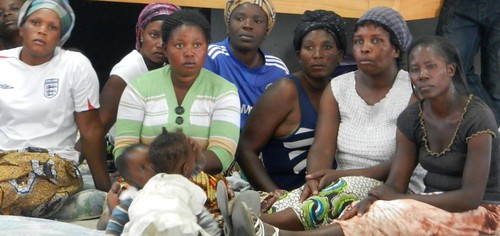
Women from Garden Park meet to discuss eviction threat
Day 2: New Secretariat systems (L,M&E, New Secretariat structures)
Day 2 was spent at the Zambian federation’s resource center in George compound with significant participation from the Zambian federation. Mara (from the SDI Secretariat) and Muturi (from the Core Team) did a fantastic job in taking everyone through some of the new systems developed by The Secretariat including the L, M &E worksheet and call for support. There was a vibrant discussion about these new systems and some very important suggestions made as to how they could be refined (e.g. definitions of certain terms such as “secure tenure” need to be clarified). These issues were noted and will be shared with the secretariat team.
A very critical issue was raised around the learning center and its role within the HUB, a number of people felt that the HUB itself was serving as the learning center. We need to think carefully about how the learning center fits into the HUB-especially in the case of Southern Africa were conditions and experiences in Cape Town are quite different to the rest of the countries. People felt strongly that different countries had different strengths (e.g. Namibia and Zimbabwe around collection of their savings number & indicators).
Day 3: HUB Business
The day was focused on collecting country reports that were compiled previously by each country. These will be used to aggregate a set of Southern African HUB figures that can be taken to the Board & Council (B&C) meeting. Each country handed in their reports but then spoke about the “burning issues” and what support was needed. This led to suggestions for further exchanges that have been noted. The HUB also discussed progress made on exchanges decided at the B&C. In general this approach was well received as countries did not use up time providing long lists of figures but rather focused on the key issues that they wished to raise. The exact role and nature of the CORE team was also explained at length.
Throughout the meeting the participation of members from Kenya, Uganda and Ghana was extremely helpful. Their insights were valuable and contributed to the discussions with government. The continuity between the East African HUB and this HUB was definitely beneficial and something that we could take forward.
An issue that emerged from some was how we can include more “voices” in the HUB and encourage everyone to participate and speak more fully. It seemed that when we broke into country teams it allowed for more even discussion and participation as opposed to just a few people speaking in the bigger forum.
A HUB report is currently being drafted by Zambia and will be shared shortly.

“Carrying” water home in Chazanga, Lusaka
South African Minister Lindiwe Sisulu’s Tribute to Patrick Hunsley at the Govan Mbeki Awards Ceremony


Today we also want to recognise an outstanding, humble man who helped us shape our policies and understand how people who live in slum conditions are not victims, that they have the power, together with our support, to take themselves out of their poverty. His name is Patrick Magebhula and he passed away on Monday 4 August 2014. It is a sad loss for us. We will bury him on Saturday with all the dignity that he deserves. Today we honour him as an internationally recognised champion and pioneer of the empowerment of the poor and acknowledge his outstanding contribution. We and his broader family of the Federation of Urban Poor and SDI will have to double our collective effort to further his work to ensure that his life passion was not in vain.
– Minister Sisulu’s heartfelt tribute to Patrick Magebhula, delivered at the annual Govan Mbeki Awards Ceremony, where she honoured him with a posthumous lifetime achievement award
National Community Exchange – Durban to Cape Town

**Cross-posted from the South African SDI Alliance blog.**
By Yolande Hendler, CORC South Africa
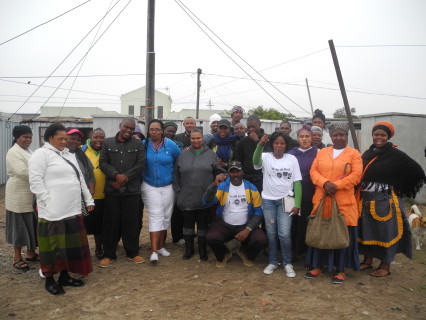
Informal settlement leaders from Kenville and Foreman Road in Durban are mobilising their communities to upgrade their settlements with better services and improved spatial layouts. Last week’s exchange to Cape Town (29 April – 2 May 2014) therefore presented a first-hand opportunity for them to draw insights from fellow community leaders.
Over the week the Durban visitors were hosted by Kuku Town, Flamingo Crescent, Langrug & Mtshini Wam communities in and around Cape Town. Each day was dedicated to an in-depth visit of each settlement. This included a detailed site visit, discussions on collecting savings, enumerating and profiling settlements and contributing to planning and mapping. Besides bringing leaders together on a national level, the exchange also connected communities locally: for leaders from Kuku Town, Flamingo and Langrug the exchange comprised a first time visit to the other settlements. Exchanges are thus the most important learning vehicle in the South African Alliance, facilitating the direct exchange of information, experience and skills between urban poor communities.
Day one in Kuku Town: Upgrading & Savings
Community leaders met in Kuku Town, a small settlement that recently completed re-blocking and in the process secured one-on-one water and sanitation services from the City of Cape Town. Read more about Kuku Town and re-blocking here. In the discussion community leaders took the visitors through a step-by-step picture of Kuku Town’s experiences. ISN representative, Melanie Manuel, explained that
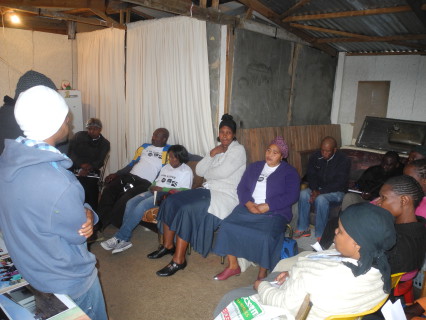
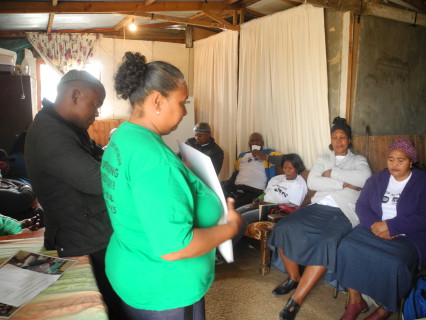
Community leaders share their experiences around organising and upgrading in Kuku Town community hall.
“What we do in ISN is not only to beautify our settlements but to actually change the way we live. Savings and partnerships – like we had with Habitat for Humanity and the municipality – are an important part of this.”
Yet, before partnerships can be formed, a community needs to know its settlement in terms of the number of (un)emloyed people, the number of structures and families and details on service provision (electricity, sanitation and water). This information is collected in enumerations. Kuku Town community used its enumeration data to plan its re-blocked layout and to negotiate the provision of one-on-one services and short-term employment opportunities through the City’s Expanded Public Works Programme (EPWP). Community leaders explained that they organised themselves in clusters to be able to navigate the logistics around communication and construction during re-blocking.
Among a variety of questions, the visitors took special interest in understanding the connection between savings and upgrading, especially the role of community contributions. Melanie explained that
“Savings contributions enable us as communities to take ownership and responsibility of the changes and upgrading in our settlements. We want to move away from a ‘free for all mindset’ and restore dignity and pride to our communities”
But collecting savings poses a continuous challenge. How to go about motivating communities and responding to accusations? Flamingo Crescent’s community leader, Auntie Marie, shared her experience:
“Getting the community’s commitment for daily savings is difficult. People only want to act when they see that things are happening. You’ve got to be tough. If you’re not tough you won’t get anything right”
For Kuku Town community leader, Verona Joseph, the partnership with the City and its support in this regard, was crucial. This became evident at Kuku Town’s official handover that afternoon which was attended by the ward councillor and City officials. The handover and a site visit completed the first day of the exchange, demonstrating what a tangible community-government partnership can look like.
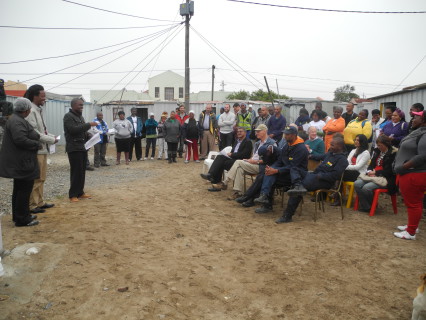
Exchange participants join handover ceremony in Kuku Town.

Kuku Town site visit: Inspecting water and sanitation units provided by the City.
Day two in Flamingo Crescent: Re-blocking and Partnerships
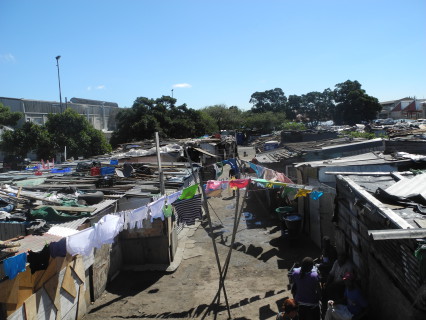
Flamingo Crescent is about to begin re-blocking and – in partnership with the City of Cape Town – is set to receive one-on-one services. On a walkabout through the smoke and dust-filled pathways community leaders received a thorough impression of the settlement’s layout. Most structures – consisting of old cardboard, zinc, timber and plastic pieces – are situated around a broad, u-shaped pathway that is intersected by smaller, narrow footpaths. Flamingo’s population of about 450 people resides in 104 structures. The entire settlement makes use of only 2 taps and 14 chemical toilets that are emptied three times a week. The absence of electricity means that fire is used as a central source for cooking and warmth.
In a nearby community hall, Flamingo’s steering committee explained its relationship with ISN and the challenge of collecting savings contributions due to its high unemployment rate (50%). Flamingo’s enumeration acted as a powerful entry point to negotiating an improved layout and service provision with the City of Cape Town. Together with students from the Cape Peninsula University of Technology and Worcester Polytechnic Institute (USA) the community designed the re-blocked layout and conceptualised plans for a crèche and a play park. Later, the visitors joined the steering committee’s meeting with a Cape Town City official who provided an update on the City’s contribution to upgrading. For the visitors this was of particular value as it emphasised the crucial role of partnerships and the number of actors involved in a given project. The question at the forefront of many minds was: how can we do this in our communities at home?
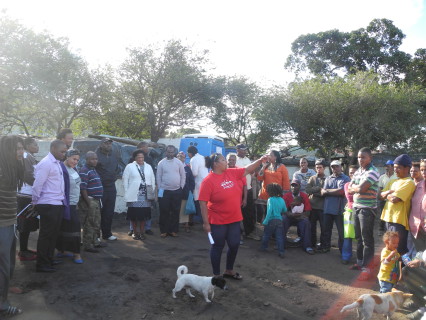

For Auntie Marie, Flamingo community leader, it is evident that
“If it wasn’t for ISN, I don’t know where we would be. Through ISN we were introduced to the City and we got a partnership. We started thinking, ‘Now something is going to happen’. Flamingo is going to be re-blocked!”
–
Check back here in the coming days for more on this exchange. In addition, you can take a look at an additional report on the exchange, put together by the Durban representatives, here.
No More Kid Mangwangwa
Both India and South Africa are voting today in parliamentary elections. But change is not something that comes about every four or five years at the ballot box. The real change-makers are on the streets, moving towns, cities, and nations, forward through their daily struggles. Pule Raboroko was one such unsung South African leader. The below is a retrospective that honours this key personality in the South African SDI Alliance. Similar short biographies of the men and women who have forged this global social movement will be featured regularly on the SDI blog.
–
“It is my subsidy you are talking about. It is you the government who promised it to us and it is you the government who tell us that the R15,000 is all we are going to get for our years of misery and suffering. And now you want me to accept it when you pour my subsidy down the drain, down your throats and the throats of developers.” – Pule Raboroko.
Pule Raboroko was stabbed to death in a Kanana shebeen in the early hours of Sunday 25 October 1998. His young wife lost a husband, his little children lost a father, the Federation (uMfelandaWonye) lost a national leader and the nation lost an unsung hero.
Pule Raboroko was an ordinary man. Pule Raboroko was never going to get a minute’s silence in parliament or an obituary in the daily papers, written by one of the venerable scribes of the new elite. It is left to his family, his community and his comrades in uMfelandaWonye to honour his memory. Raboroko would have preferred it that way.
He was born in Sebokeng in the late 1950’s. Like millions in his generation he grew up with the painfully simple aspiration to help to overturn the apartheid regime that tormented and degraded him. Raboroko grew up to be a proud man who did not like to be humiliated. He wore his wounded manhood on his sleeve, and in the end it might well have cost him his life. Just like it has cost the lives of countless men in this country’s racially segregated ghettos.
Pule Raboroko spent 15 years of his adult life in a back-yard shack in Sebokeng. In 1983 he was in the forefront of the riots that rocked the Vaal and ratched up the fear and the desperation of the white state. He was a member of UDF and ANC street committees until 1994.
On the day of the elections he led his people out of the backyard shacks and into a promised land – 15 hectares of dry veld that, of course, was called Kanana. In the eyes of the new authorities (what did Fanon say – Black skin, White masks?) that act made Raboroko into a land-grabber, a leader of queue jumpers, someone who undermines development and profits from the desperation of the poor.
Raboroko was no angel, but he did deliver 3000 homeless families in the Vaal Triangle from decades of humiliation and extortion in the backyard shacks of Sebokeng. And this action inspired thousands of others to follow this example, for Raboroko had exposed a universal truth. Government queues don’t move, they just groove for the corrupt. Government threatens land invaders with harsh recrimination, but nothing gets government to negotiate as quickly as a land invasion.
It is not the point to praise or condemn invasions, but by honouring Raboroko’s memory we honour the real urban planners of our cities – those men and women who have been desperate enough to occupy land, build shacks, source water at great risk to themselves and their loved ones.
First came the backyard shack-dwellers of Sebokeng. Then came their comrades from Small Farm, Evaton, Sharpeville. Soon the settlement of Kanana was followed by Election Park, Boitumelo, Botshabelo … And Raboroko was always at hand to help his fellow squatter citizens, to block out sites, to draw as good a layout plan as any professional surveyor, to design and help build infrastructure, to provide water.
The politicians did not believe him when he told them that he was not undermining Government but was helping them to deliver on their promises. The people did. Not only the people in the Vaal, but poor people throughout the land.
They are crying for Pule Raboroko today in hundreds of informal settlements throughout South Africa. They mourn him in Joe Slovo Village, Despatch where he helped design a layout plan that helped settle two thousands families. They mourn him in VukuZenzele, Cape Town where he did the same for 250 families more. And the women in Nonzamo, Queenstown are wailing for the soul of the man who helped them get running water. The men in Newlands West, Durban sit silent and solemn by the side of their stoves, thinking of the man who was with them when they fled the violence in Siyanda and sought a safe place to live. And it is a pall of sadness as well as a pall of smoke that covers the shack settlements of the Vaal region this week. There is hardly a squatter family in Kanana, Agrinette Hills, Patrick Hunsley, Election Park, Boitumelo that is not reminded that it was not the liberty that was awarded them by this new government that gave them land.
In the time of the bitter arrival of freedom, Raboroko was your everyman. Raboroko was a rough, even violent and self-destructive man. But then he was a product of the urban shacklands, and violence and roughness is the equilibrium of the shacks. So why is it so difficult to recognise that rough men like Raboroko who are committed to their communities are central to our urban transformation? Why point self-righteously at his scars, why look at his warpaint and say “I told you so”? Why not rise above the insalubrious, just like Raboroko did?
In the city centres and the suburbs where planners and politicians live, memory subsides into the new demands of reconciliation and consumption. On the outskirts where Pule lived, and debauched and tried to build a better life with his fellow squatter citizens, people have nothing and so they survive on memory. Not rigid, not dogmatic, not even angry, but the memory of old roots, the memory of community, a memory that spreads over time, carried by imperfect heroes like Pule Raboroko. It is that memory kept alive that is the key to a better tomorrow. It is not a sanitised solution, ribboned with red tape. It is beauty replete with horror. It is the simple order in the very heart of disorder.
A cowardly thrust of cold steel on a dark night and the Federation lost its first urban planner. Not a well heeled professional, schooled in an urban grammer, made up of grids and regulations, but a multi-lingual, multi-historical visionary, trapped for a lifetime in a mosiac of shacks and unlit streets and stagnant puddles. This was his backdrop. This was his home – be it in Kanana or Piesang River, Khayelitsha or Cato Crest. Our urban planner took the Federation’s message to the formal world – where he and his colleagues were often ignored and ridiculed.
But what is it that the Raboroko’s of the Federation are trying to say? That development is not a linear progression to be mapped and regulated. It is a process whereby the poor themselves show the way to make throbbing mosaics out of the haphazard whirls of life.
There will not be a minute’s silence in Parliament for Pule Raboroko, but the women of the Federation hold his memory to their hearts and their whispers accompany his spirit on its journey to his ancestors. Our tired eyes are burning with tears held back, as if by clouds of thick smoke on a highveld night, dust, and a wind as sharp and merciless as death.
Mandela Speaks to South African Federation on Role of Communities in Building a Better Society for All

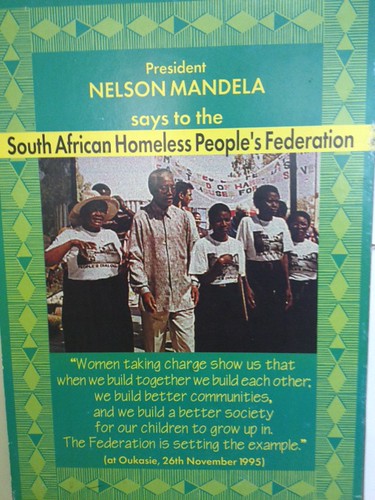
In 1995, shortly after being elected the first democratic president of South Africa, Nelson Mandela visited the Homeless People’s Federaiton of South Africa (now called Federation of the Urban Poor) in Oukasie, Gauteng. Oukasie is the home to one of South Africa’s oldest savings schemes, started by Rose Molokoane, one of the founding members of the South African Federation.
In his address to the Federation members of Oukasie, Mr. Mandela talks about the importance of government working together with the urban poor to meet South Africa’s housing challenge – a major challenge in 1995, and perhaps even a greater challenge today. He highlighted the important role of women in working to acquire safe, secure housing, stating the following notable point:
“You are showing that in building together we build each other, better communities and a better society for our children to grow up in.”
Today, the South African Federation of the Urban Poor has reached a critical mass consisting of some 1,500 autonomous savings and credit groups whose size range from a minimum of 15 to a maximum of 500 members. Since Mandela’s address in 1995, FEDUP has established itself as an international pioneer in the field of tenure security and people’s housing. Through its collective power, this network was able to lobby government for direct access to the housing subsidy programme (without the interference of developers or contractors), secure 10 million rand as a revolving loan facility, and heavily influence low-income housing policy under “the People’s Housing Process” (PHP). By securing these entitlements from the national government, the Federation was able to deliver 12,000 housing units (average size being 56sqm), incremental loans for a further 2,000 houses, infrastructure for 2,500 families, land tenure for 12,000 families, hundreds of small business loans, three parcels of commercial land, eleven community centres, and several crèches. This was all administered through its own housing finance facility, the uTshani Fund.
These days FEDUP and uTshani are still actively building houses and engaging government on the re-directing of housing subsidies to support people-centred, participatory and empowering development. Being strategically aligned to the Informal Settlement Network (ISN), FEDUP members are adding years of experience to the relatively new experience of informal settlement upgrading. The creative synergies at the intersections of a woman’s movements anchored in daily savings and livelihood strategies and a predominantly male-led and broad based social movement are redefining the social mobilisation “rituals”.
You can read Mandela’s full address below:
Mr. Mayor;
Members of the Homeless People’s Federation;
Citizens of Oukasie, Brits and neighbouring areas
The rains of the past week have brought joy to many in our country, not least in this fertile farming area.
But the drenching downpours have also highlighted one of the great challenges facing our country – the challenge of putting decent roofs over people’s heads.
In approaching this task we have learned a great deal from the people – from those who are the biggest providers of housing in the country, the homeless themselves. We have learned the value of partnership between ourselves and the people in their communities.
We recognise the efforts but into housing by the people themselves. We are proud of the way our people use their initiative, mobilise their meagre resources, sharpen their skills, and put in their labour, in order to provide shelter for their families.
Government has committed itself to supporting the people’s housing process. We will provide mechanisms and funds to support it in such a way that the standard of housing can improve – particularly for the poorest of our people.
What I have seen here today confirms that this is the right course. The Homeless People’s Federation, with its 20 000 members across the country and its savings and training schemes, is setting an example of Masakhane in action.
What is particularly encouraging is to see the women taking their lives into their own hands, taking charge, determined to improve the lives of the communities and of our country.
You are showing that in building together we build each other, better communities and a better society for our children to grow up in. You are showing that with the interfere in the legal process, but it is not disinterested in the case whose outcome, we believe, will have wide impact.
Government is busy formulating a police on the ownership of mineral resources. Consultation will ensure that the resulting policy accommodates the aspirations of all stakeholders while ensuring that the mining industry retains its central position within the engine room of economic reconstruction.
Amongst our strategic objectives is the goal of ensuring that mining rights are made available to small entrepreneurs and that ownership of the industry is opened up to previously excluded communities. This also was the vision of Kgosi Lebone Molotlegi. It will be the duty of his successor, the Bafokeng people, and indeed all the people of South Africa, to continue the struggle for economic empowerment on all fronts.
During this delicate period of mourning and transition we urge the members of this community to close ranks and not to allow differences op opinion to drive them apart. You are one people. The practice of prohibiting non-Bafokeng persons from being buried in the same graveyard, regardless of their sojourn within this community, is a blight on the esteem and respect in which our nation holds this community and on the dignity of Kgosi Molotlegi in particular. Nevertheless, this issue should be left to the community to sort out on its own in accordance with the new culture of our rainbow nation.
Kgosi Lebone departed at a time when we had just concluded our first democratic community elections. The establishment of democratic local authorities in rural areas needs to be handled with great sensitivity. We are confident that this community will assist the new leader to play his constructive role in the process. In all villages under Kgosi Lebone’s jurisdiction, the elections went smoothly, and we look forward to an equally smooth establishment of local councils.
This is in everyone’s interest. We need one another and we all have a role to play now and in the future. The improvement of our lives and the future stability of our localities depend on these councils. An amicable relationship between the Kgosi and the newly-elected councillors will give local democracy in the rural areas a strong foundation.
Bafokeng People;
As we bid our final farewell to our beloved Kgosi Lebone, let us look back at his heroic record and reflect on the love he had for this community. Let us, for a moment, focus on his vision of a prosperous future and pledge that we shall never rest until that ideal is realised.
Thank you.
Issued by: Office of the President
Originally appeared on SAHistory.gov.za
City Finance That Works For and With The Poor


By Mara Forbes, Ariana MacPherson, and Noah Schermbrucker, SDI Secretariat
Flows of finance and the systems that perpetuate resource distribution are inherently weighted against inclusion of the poor. The inequality of rapid urban development in developing countries is a clear demonstration of this phenomenon. Banks do not supply loans on terms affordable to slum dwellers, cities sink budgets into formal taxpaying areas rather than informal settlements while policies, rules and regulations prop up a grossly uneven distribution of wealth. Traditional market finance does not work for the poor on a city scale – slums continue to grow, as does the gap between rich and poor.
Finance for the poor demands flexibility. It demands understanding how poor people save money, how piecemeal incomes fluctuate, what interest rates and loan amounts are really affordable and what investments make sense locally. It also means understanding how to incorporate community-based financial systems, in addition to those pitched at individuals and households.
Flexible citywide urban poor funds need to change existing systems of exclusionary finance. Local government is a change vector that cannot be dismissed and their inclusion in these funds has the potential to create citywide political impact. Organized communities, who can clearly articulate their demands and the rationale for their financial decisions, can negotiate this space ensuring that funds remain relevant to the poor.
Community-based urban poor federation members and support professionals from South Africa, Malawi, Zambia, Zimbabwe, Uganda and Bolivia came together in late 2013 to discuss citywide models for urban finance. They drew on extensive experience in managing urban poor funds in their various contexts to explore the design, political impact and practical slum upgrading benefits of flexible pro-poor finance facilities.
South Africa
The context in South Africa is one of at a subsidy-based development state, where many urban poor communities’ – and governments’ – mindset is one of state delivery. This, despite the fact that evidence shows that government is incapable of delivering housing or infrastructure services at the scale necessary. This challenge is central to the experience of informal settlement upgrading, both at the level of the community and in relating to government around new practices and policies that are seen to undermine the government’s responsibility to provide subsidized housing and basic services to the country’s informal population. Despite the available subsidies, much of South Africa’s population continues to live in insecure conditions without access to basic services, secure shelter or economic opportunity[1]. To date, there have been few alternative solutions to informal settlement upgrading in the South African context, but it is clear that new political and financial systems are necessary for the nation’s urban poor to become active participants in the development of inclusive, equitable cities. Central to this is the need for an alternative financing strategy – one that is sensitive to the needs and daily realities of the urban poor.
These issues were addressed at length during the South African delegation’s discussions of the formation of a citywide upgrading fund in Cape Town. Although the South African SDI Alliance[2] has adopted the Community Upgrading Finance Facility (CUFF), it has faced challenges in rolling it out as tool for informal settlement upgrading at scale and with support (financial and political) from local government. CUFF was created with the aim of providing a platform for informal communities to “engage government more actively around collaborative upgrading & livelihood projects” (CUFF Project Report 2013). The Fund does this by providing seed capital for settlement improvement projects that are proposed by communities. At the same time, communities must provide a 20% contribution to the total cost of the project, demonstrating their willingness to take ownership and participate in the co-production of their settlement’s upgrading and development.
During the recent exchange in Cape Town, the South African SDI Alliance had an opportunity to reflect on the implementation of CUFF to date. The Alliance emphasized that CUFF is not just about implementing projects, but about influencing policy. The Alliance stressed the significant value of community-based finance facilities like CUFF as learning instruments designed to change the mindsets of communities and governments – to change the mindset of communities away from dependency on the state, and to chance the mindset of government towards considering that communities may be able to offer in-situ solutions to their infrastructure and housing needs.
CUFF in its current incarnation is not set up as a citywide fund to which a broad base of stakeholders, including local government, other community-based organizations and non-government organizations contribute and access resources. The inclusion of a wider base of stakeholders is critical in order to moves from a fund that is only for federation members to a collective fund that allows for loans for entire settlements. This critical point motivated the South African delegation to discuss how to move CUFF into a position where citywide scaling up becomes a real possibility.
Uganda
The situation in Uganda contrasts sharply with South Africa, leading to a different thinking and organization around finance facilities. There are no government subsidies so the poor have had to find alternative ways to finance upgrading initiatives.
Uganda has set up a national urban poor fund and used lessons learned to think through and design potential citywide funds. The goal of the fund to is to provide capital in the form of loans to members of the National Slum Dwellers Federation of Uganda (NSDFU). The decision to only provide group loans from the fund is deliberate. These funds are intended to benefit the larger community through group upgrading projects that set precedents for community urban development projects. Loans are given out for housing, sanitation, and group livelihood projects. To date the fund has extended loans for 44 projects in Kampala. The fund is designed as a sustainable revolving basket fund. It receives funds from a variety of sources, including contributions from NSDFU and community saving groups, fundraising activities, government contributions, donations from local and international institutions, subscriptions fees, and UPFI loans. Particular to note about Uganda’s fund is that loans are not available to individual members, but to savings groups for community upgrading projects.
Although the fund provides alternative financing solutions to the poor in Uganda, it has a larger purpose and vision. The federation uses the fund to build precedent-setting pilot projects that will attract government and other urban development stakeholders. It is not just about urban poor participation and decision-making but about using the fund as a tool to push an urban poor agenda, with sanitation being the key issue advocated in the Ugandan context. The community is able to demonstrate they are able to contribute savings to grow the fund which allows them to access a group loan to build a community sanitation unit. This process demonstrates the community’s ability to prioritize, contribute, and implement slum-upgrading projects. This work has altered the city government’s outlook on sanitation, the first step to effecting policy change.
The Ugandan federation has been able to use the urban poor fund not only to pilot community projects but also to shift the mindset of local government to eventually bring change in city policies. They have connected the role and strength of women-led savings schemes to each level of the fund.
Why is a city fund needed if a working national urban poor fund is in place? These were some of the questions examined during the exchange. Delegates were convinced that a citywide fund moves from a fund that is only for federation members to a collective fund that allows loans for entire settlements. This would allow local governments and other urban development stakeholders to channel money directly to communities to support infrastructure and upgrading projects that benefit whole communities and cities.
Zimbabwe
The Zimbabwean context is one in which the state has practically no internal resources available for the urban poor. Donor funds are channeled through departments at the local government level, but this is not a sustainable means of income. Despite acute resource scarcity the Zimbabwean federation has forged deep and meaningful partnerships with local government, changing attitudes towards evictions, introducing new sanitation technologies and leveraging technical and political support.
A dearth of government finance motivated urban poor communities to organize their own savings, not just for daily needs but also nationally through the Guungano Urban Poor Fund. The fund not only provides low interest rates on loans for the upgrading needs of poor communities but also has a political agenda that opens space for negotiation with local governments. Ideally the fund would like to attract government finance, but this has not yet been the case. The overly bureaucratic and politicized nature of government institutions undoubtedly contributes to the difficulties associated with accessing government funds.
Based on their experiences of administering an urban poor fund at the national level, the Zimbabwean federation decided to decentralize the fund to regional (Bulawayo & Matabeleland South) and citywide scale (Kariba and Masvingo). This speaks to the differences between national funds and citywide funds at a larger scale – a strategic move that is beginning to play out across the SDI network in divergent contexts.
In Harare, the Zimbabwean federation is in the advanced stages of negotiating a fund with city authorities. The lessons learnt through the administration of the Guungano fund both nationally and in its newer regional structure come to bear on these negotiations. The fund will become part of the implementation strategy of the cities new slum upgrading policy. The federation will contribute $25,000, the UPFI $50,000 and the City $125,000. The fund will not be housed in either the federation or the City Council and will focus on slum upgrading (incremental housing, water & sanitation and other infrastructure). Projects will be determined through community profiles and enumerations and loans will revolve. The city pushed for the fund to be registered as a microfinance institution, however the community was adamant that this would lead to systems that excluded the poor. The city has now agreed to register the fund as a trust.
While negotiations continue it is clear that an organized community who can clearly articulate the rationale (the why) behind a city fund can have significant traction in shaping its structure and mechanisms. If these regulations are entrenched in a constitution the potential for a new type of financial instrument is created.
Bolivia
Despite attempts by Bolivia’s central government over the past decades to implement a social housing policy that addresses the country’s growing housing deficit, little progress has actually been made in providing a housing and infrastructure finance system that is accessible to the country’s urban poor population.[3] It is estimated that about one third of the housing constructed each year in Bolivia is informal and largely illegal, with urban poor families occupying self-constructed, insecure structures with little or no access to basic services like water, electricity and sanitation.[4]
In light of this it becomes clear that an alternative solution is necessary to begin to meet the growing demand for affordable housing finance and informal settlement upgrading at a scale that can adequately address these needs in light of Bolivia’s rapid urbanization.[5]
At the exchange the Bolivian delegation spoke about their own solution to some of the housing and basic service challenges faced by Bolivia’s urban poor. The Fondo Para Vivienda Popular (Popular Housing Fund) was created in 2011 with a small donation of only USD 160 to be used for loans to assist with the costs associated with regularization of shelters in informal settlements in Cochabamba, Oruro and Santa Cruz. After about a year of operating as a national fund it was decided to split the fund into three localized city funds. Now, only two years later, the fund has grown to USD 10,000 through a combination of community savings and donations from individuals, the private sector and donor agencies. The objective of the Fund is to serve as a tool for the federation of women’s savings groups, Tejiendo Ciudades (Weaving Together Cities), to provide low-interest loans[6] for the needs and demands of savings group members. These include: housing repairs, regularization papers, water, electricity, sanitation, furniture and appliances.
In 2012, the Federation disbursed twenty individual loans and one collective loan. In 2013, these numbers rose to thirty individual loans and two collective loans with all loans in both years having been repaid in full. While the Fund is off to a steady and impressive start, there is a need to involve a wider network of stakeholders, including local government, in providing capital for the fund, if it is going to become a scalable solution to housing and basic service finance in Bolivia’s urban sector.
Zambia
The Zambian federation has two funds, an urban poor fund and a city fund. The urban poor fund currently operates regionally and is controlled and managed by the federation. The urban poor fund has been working at a larger community level with both federation and non-federation members.
The city fund emerged from a need that was generated by profiling and enumeration in Lusaka. A potential commitment from the Lusaka City Council to contribute 35% to the fund has been tabled.
One of the crucial learning’s from the Zambian federation is the need for a citywide fund to be accessible and benefit not just federation members, but all of the urban poor. The fund can also then be used as an advocacy tool that introduces communities to savings culture and rituals of the federation. In order for a citywide fund to go to scale alignments and partnerships with other actors, such as local government, must be made. The Lusaka city fund has demonstrated how federation rituals (profiling and enumerations) can be used to get the local governments attention and bring them into the process. The Zambian example demonstrates how a fund was used to change the way government relates to and includes the poor.
Malawi
The Malawian context is one in which government has made limited investment in slum upgrading. Foreign NGO’s and donors have invested in the various facets of the development sector but foreign aid is not a long term and sustainable solution, and the donor community is beginning to pull out of Malawi as well, further highlighting the need for a sustainable source of funds for slum upgrading projects.
Daily savings for basic needs is the core strength of the Malawian federation. At a larger scale, the Mchenga urban poor fund has allowed community members to take out loans to build eco-san toilets and water connections. A community contribution of 10% is required and all community members, not just the federation, can access loans. Loan repayments are revolved back into the fund and used to provide further loans and attain maximum scale.
More recently citywide funds, and the challenges that they can present, have come into focus in Lilongwe. Donor finance was used as seed capital for a citywide fund for slum upgrading activities. The fund was envisioned as one in which the city and communities would collectively plan for slum infrastructure improvements. However the communities found it difficult to engage the city and access the funds – or even have a significant role in decision making around their distribution. The city only began to include communities in decision-making processes when the donor threatened to take the money back. The fund has since been used to construct markets, install water points, improve drainage, install water tanks and build roads and bridges. Funds were distributed as grants and not loans, prompting the question, “If communities don’t have to repay the funds, how do they influence government to use funds to their advantage?”
Conclusion
The introduction to this report stresses that new types of finance are needed to make affordable capital available to the poor. A concomitant political shift at the local government level has the possibility to entrench these new modes of financial distribution at a city scale. However this can be a double-edged sword, with government retaining de-facto control of city funds and communities relegated to the role of passive beneficiaries. Strong and organized communities are able to negotiate the terms of funds clearly articulating structures and rules that make sense on the ground. Thus while citywide funds need local government participation to reach scale, they often do not need the traditional systems through which state funds are distributed and managed.
Click here for the full report, and here for the City Funds Manual that came out of this exchange.
[1] According to the 2001 census, approximately 2 million households live in informal housing across South Africa, the majority of those in urban informal settlements. South Africa: Informal settlements status, The Housing Development Agency, 2012.
[2] The SA SDI Alliance is made up of two community-based organizations, the Federation of the Urban Poor (FEDUP) and the Informal Settlement Network (ISN), and three support NGOs, the Community Organization Resource Centre (CORC), uTshani Fund and iKhayalami. To learn more, visit: www.sasdialliance.org.za.
[3] “Over half of Bolivia’s poor (2.9 million) and 43% of the extreme poor (1.4 million) were living in urban areas in 2002, up from one third (1.8 million) and one fourth (800 thousand) in 1997, respectively.” Housing Finance Mechanisms in Bolivia, UN Habitat, 2008, p.25.
[4] Basic service coverage remains highly unequal in Bolivia, with coverage sitting at 93% (water) and 80% (sanitation) for the richest income quintile, but only 38% (water) and 14% (sanitation) for the poorest quintile (in 2003). Ibid, p. 28.
[5] Between 1976 and 2001, the urban population increased 168%. In 2001, the urban growth rate in three of the main urban areas (La Paz, El Alto & Santa Cruz) reached beyond 5%. Ibid, p. 24.
[6] Interest rates are .5% per month for a period of up to 6 months.
From ‘My Slum’ to ‘My City’ : Action Steps towards Global Slum Profiling


By Anni Beukes, SDI Secretariat
“We are able to appreciate that we need to have a more holistic view of the cities where we are working” (Frederick Mugisa, Uganda, SDI Alliance).
“…now we are planning the profiling in the settlements we are working and also see city wide settlement profiling to help in planning of the city with the slum dwellers” (Shekar and John Samuel, NSDF/SPARC, India, SDI Alliance)
While focus on the local remains the core concern of SDI federations, the question, increasingly pertinent is, how does the global network of the urban poor make itself globally visible and relevant on the global urban development agenda? Peer exchanges have long served SDI federations as a learning space to share experiences of everyday life. They serve as a platform from which urban poor communities can share local concerns, challenges and successes. Like SDI enumerations and settlement profiles they too have traditionally been centred on particular contexts and the particular concerns of local slum dwellers.
SDI and Santa Fe Institute’s (SFI) global slum profiling project aims to aggregate and analyse the around 7,000 federation profiles collected over the past twenty years in more than 15 countries across the global south. The objective is to yield a “science of slums” powerful enough to leverage city wide and global sustainable developmental appeal for ‘slum data’. With renewed vigour the network is looking towards two of its most powerful tools (exchanges and enumerations) as learning and innovation spaces to foster this goal.
Making slum communities visible to their local authorities has been the driving force behind local actions to stave off evictions and leverage land, basic services and upgrading of slums. Mugisa, Shekar and Samuel’s appreciation of the value of the June learning exchange around the SDI and SFI Partnership, during the SDI-SFI Field Visit Cape Town June 2013, echoes the hope expressed by Sheela Patel, director of Indian NGO SPARC and SDI Board Member, that “communities of the urban poor living in informal settlements [will come] to believe that aggregating information about settlement and households is a valuable tool towards improving their lives” (Patel in Fieuw 2013 and elsewhere ).


Over the course of ten days in and around Cape Town’s UT Section, Khayelitsha, federation members along with NGO support staff from Malawi, Kenya, India, Zimbabwe, Uganda, South Africa and Namibia were able to test the new tools (including a questionnaire, geo-tagging smart phone application, etc.) developed through the SDI-SFI collaboration to improve and standardise the data capturing processes of the network. Rosey Mashimbye of FEDUP, South Africa, commented that the use of these new technologies is certainly an improvement from manual capturing. While there remain some concerns among federation members that the new standardised questionnaire may not speak to all their local concerns, according to the Namibian alliance’s report, “standardised rituals and practices [may have] the possibility to incorporate local concerns/issues” (Harris, Namibia Alliance).
Informal settlement communities have come a long way in showing that their settlements and communities are not just spaces of perceived and real deprivation, but rather innovation and resourcefulness. They have consistently shown that slum dwellers themselves are the most capable of showing local authorities, who they are, how they live, make their livelihoods and contribute to the economies of the cities from which they are so often excluded. By standardising profiling and enumerations and marrying our techniques to cutting edge technology and analysis through the learning space of peer-exchanges, we are well on our way to leverage on of the most powerful tools of the federations of the urban poor in creating sustainable and resilient inclusive cities.
For more on SDI enumerations and profiling see pages 46-52 in our latest Annual Report.
From the Bottom Up: Connecting SDI to Global Urban Development Processes


SDI signs an MOU with Cities Alliance and United Cities & Local Governments of Africa (UCLGA).
The experience of federations of the urban poor that make up the SDI network underlines the interconnections of actions that impact both locally and globally. Every time a foreign corporation, government, or other type of organization expresses interest in land or development in a city or in a country, it impacts the everyday lives of the poor. The people who live in cities, and their governments, face constant external pressures regarding the choices that determine whether ordinary poor people have access to land, services, shelter, and economic opportunity.
The challenge, then, is to build organizations and alliances able to balance the influence of powerful global processes with local needs to make urbanization work for all. The lesson here is that local actors, especially in city government, through exploring the potential of working and supporting citywide federations of the urban poor, become more effective in managing these processes.
At the global level, SDI is increasingly serving as a platform for allowing representatives of organized urban poor constituencies to speak directly with decision-makers in major international organizations and forums. The aim and impact of these interactions is to strengthen the local processes through which federations form and build citywide alliances. How do they do it?
First, by building new mechanisms for accessing and managing the financial resources required for an inclusive vision of development. The global financial flows that drive city development comprise a juggernaut in comparison to the amounts of money the federations of savings schemes collect. However, these savings serve as the basis for creating citywide funds to finance informal settlement upgrading projects and employment generation projects. Savings also builds financial literacy and management skills amongst the organizations of the poor in order to take up projects to upgrade and improve their settlements with the city

Even more promising is the spread of citywide funds that are joint endeavors between city governments and city federations. These institutions have begun to get formalized in different forms in cities in South Africa, Uganda and Zimbabwe. They provide the space for city governments and federations to work together to leverage resources within government, within communities, as well as from external institutions in the private sector. These are quintessential examples of the ways in which urban poor federations are a mechanism through which city governments can get a handle on flows of finance that impact urbanization.
–
Harare Citywide Slum Upgrading Fund
In Zimbabwe, Dialogue on Shelter, an NGO affiliated with Shack/Slum Dwellers International (SDI) is in the final stages of negotiating the terms of a citywide fund with the City of Harare. The fund is a practical financial instrument reflective of the partnership between the Zimbabwean SDI alliance and the city, creating shared political and financial responsibility for slum upgrading.
The fund will comprise of financial contributions from SDI, the City of Harare and the Zimbabwe Homeless People’s Federation. Other donors have also expressed an interest in contributing to the fund, making it a possible conduit for finances to flow from donors to the urban poor. Not only does this blending of finance create an attractive mechanism to which various parties can contribute but it is a manner in which the participating parties can hold each other accountable.
The negotiations about the fund’s financial structure reflect a concrete manner in which groups of the urban poor can influence financial flows that directly affect their lives. Opening this political space for communities to articulate their needs at a citywide decision-making level is core to SDI’s role, and in the case of Zimbabwe, reflective of long-term partnership building. The Zimbabwean federation argued for the fund to focus on incremental settlement upgrading as opposed to only housing, forwarded loan provision and repayment strategies based on their experiences of daily savings, addressed issues of affordability and planned to extend loans to non-federation members.
This is a clear example of how a voice of the urban poor can negotiate changes that have the potential for citywide impact in a manner beneficial to the poor and more contextualized in “on the ground” circumstances.
–
The calculation shifts. No longer is it a struggle of poor people to self-finance improvements to their settlements amidst national and global processes that often increase the vulnerability of the poor. Rather, poor people’s organizations and city governments are now working together to generate internal and external financial power to achieve the kinds of infrastructure improvements that reduce vulnerability and increase opportunity.
SDI’s global reach then allows for these experiences to add up through exchanges amongst cities, and exposure of agencies and corporations in both the private and public sectors. Now, globalized flows of finance are beginning to contend with the alternative approaches that SDI federations are enabling at the local level.
Second, the dearth of information about informal settlements persists, even amidst global trends of “big data,” “city sensing,” etc. With over 9000 city profiles and 4000 enumerations, SDI federations are becoming world leaders in generating data about informal life in cities. In partnership with the Santa Fe Institute, with a focus on uncovering complex processes of development, SDI federations are finding new ways to use their data to show the hidden side of vulnerability and survival that is the daily experience of the urban poor. Instead of being invisible, or having their homes and livelihoods thought of merely as hotbeds of crime and disease, urban poor federations are making the case, through hard data, that informal settlements have the potential to be the engines for more inclusive strategies of city development.
–
Enumeration Data Leads to Slum Upgrading in Uganda
In Uganda, the National Slum Dwellers Federation (NSDFU) acknowledges that “Knowledge is Power” and that this power is something that slum dwellers on the ground can wield if they are organized. To this end, NSDFU has completed five citywide slum enumerations in the secondary cities of Jinja, Arua, Mbale, Mbarara, and Kabale. The Federation understands that this information, gathered by communities, is trusted and more accurate because of the participatory approach employed. In each of these five municipalities the information collected has been used to plan slum upgrading projects and prioritize future projects. The information has also been central in negotiations with local authorities and has been used in Municipal Development Forums to lobby for upgrading funds and improved services. In addition, the data has been used by municipal planning and budgeting committees, helping federation members to gain seats on these committees. The information is also used internally by the federation to guide project planning, highlighting communities’ needs. For example, in Mbale the federation’s data collection skills resulted in the municipality employing federation members and using their tools to help collect informal household and informal market data which will be used to inform city wide development plans by communities and local authorities.
–
Bit by bit, this information is showing policy-makers and global decision-makers that development that is equitable and sustainable is impossible without addressing the needs and vulnerabilities of the poor. This is particularly so with respect to prioritizing basic infrastructure and shelter. Likewise, this requires prioritizing economic development approaches that finally recognize the strategies that people in informal settlements use to survive and, sometimes, thrive.

Jockin Arputham speaks on a panel at a plenary session at World Urban Forum 6 in Naples, Italy.
Third and finally, urban poor federations in the SDI network are not letting the data and the experts do the talking for them. Instead, they attend global forums and present their own understanding of the power of relationships of learning, and share its impact on their long-standing approaches to negotiation and exchange. Through peer exchanges, the strategies of learning and negotiations undertaken in one country are shared across SDI. As these practices demonstrate their application in different countries and in different contexts they can be presented externally as possible strategies for governments and development agencies to explore.
SDI federations have a long tradition of taking their partners in city governments with them as they travel to other cities and countries. In this way, federations in countries such as India, Kenya, Malawi, Philippines, South Africa, Uganda, Zambia, and Zimbabwe, have utilized international forums and exchange programs to help build more inclusive and participatory institutions at the national and city level for making decisions about developmental priorities and programs.
–

Changing the Approach to Upgrading: Expanding Learning in Southern Africa
In South Africa, the local SDI Alliance, in partnership with the City of Cape Town, is engaged in pilot upgrading projects in 22 settlements across the city. The Alliance’s work in one of these settlements, Mtshini Wam, which has included re-blocking and upgrading of shacks, has drawn local, national and international attention and has contributed to the drafting of a re-blocking policy for slum upgrading in Cape Town. In addition, technical teams from support NGOs iKhayalami and CORC have expanded training workshops for the Federation of the Urban Poor (FEDUP), the Informal Settlement Network (ISN), and local communities beyond Cape Town and Stellenbosch to settlements in the provinces of the Eastern Cape, KwaZulu-Natal and Gauteng. As a result, communities have begun working with government to develop settlement plans that involve upgraded services and homes.
These skills and learning are being transferred to other affiliates through international learning exchanges. In March 2013, a delegation from the Namibian SDI affiliate, accompanied by a delegation from the Gobabis local municipality, traveled to Stellenbosch, South Africa to learn about the impact of linking enumerations to slum upgrading. Following this interaction, the Gobabis municipality resolved to work with the local community on the re-blocking of settlements in their municipality.
–
To read more on how starting from the bottom up and connecting on-the-ground activities to global urban development processes leads to effective change, read our 2012 / 2013 Annual Report.
From Processes to Outcomes: Community-Driven Solutions to Finance, Planning & Politics


SDI President, Mr. Jockin Arputham (Right), signs MoU with Mr. Conrad Sidego, Mayor of Stellenbosch Municipality, in Langrug settlement, South Africa.
Our network of urban poor federations has, over almost two decades, pioneered community organization strategies that are able to influence formal authorities in an age of quickening city growth. SDI’s “ten cities” program over the past three years has made clear the terms of engagement for building cities that include the poor. The link between the “hard” outcomes of infrastructure accessibility and economic opportunity, and the “soft” processes of planning and decision-making for provision of such infrastructure is the chief driver of urban development today.
The urban poor federations and professional NGOs that comprise the SDI network now have a set of experiences that speak to the main challenges that persist in engaging the link of processes and outcomes. We understand these challenges through three major themes of finance, planning, and politics.
Finance
We have learned that financing shelter for the poor is about much more than mobilizing the resources for increasing access to land, services and housing. Most important is developing the systems for delivering projects and scaling up projects that make this finance meaningful. The urban poor federations in the SDI network have used the basic unit of the savings group as the means of building financial capacity in order to impact project planning and political capacity internally. The lessons from these experiences implicate persistent trends towards highly rational top-down project financing for city development.
Our approach to evaluating calls for funds from individual affiliates has always emphasized the need for projects to leverage: (a) funds from external sources, in addition to SDI’s Urban Poor Fund International (UPFI), and (b) relationships with formal authorities that extend the voice of the urban poor in planning and decision-making. This report shows how thinking about the financial equation of urban development in this way changes the ways in which projects actually get delivered.
When SDI federations have tried out alternative development financing approaches with government authorities they trigger new relationships that can scale up project delivery at citywide scale. For example, in Pune, authorities were utilizing funds for informal settlement upgrading projects that often could not reach their promised delivery outcomes. Both grassroots leaders in Mahila Milan and bureaucratic officials acknowledge that it has not been the lack of allocated funds that made projects often fail to get off the ground. Instead, the primary impediments were the top-down mechanisms for using the funds that excluded community priorities and voices.
So the Indian Alliance worked to build partnerships with government programs to demonstrate through practice how these institutions can be better designed to put more of the financial management and decision-making in a joint relationship with informal settlement community leadership. Now the Indian Alliance has been able to make federated groups of women-led savings groups in Mahila Milan an intermediary institutional mechanism for large-scale delivery of upgraded informal settlements, especially in terms of provision of housing and communal toilets.


Planning
We have learned that planning is not just about policies and physical designs on paper. Most important are the specific institutional designs and relationships through which physical planning interventions occur. By building accountable and strategic leadership at the citywide level, urban poor federations in the SDI network are creating an institutional mechanism through which development decision-making can change meaningfully. These experiences suggest that governments, especially at the city level, need to focus on supporting and engaging the mobilization of urban poor communities to represent themselves and network across the city. Once informal settlement communities have strong, accountable leadership and network across the city, they are able to put forth an articulate vision with authentic grassroots backing. Likewise, governments are enabled to orient development decision-making to incorporate better the priorities of urban poor communities, and to counter-balance much more dominant actors that drive urban growth.


One approach has been to scale up community planning activities, such as profiling, enumeration, and mapping, to regional and citywide scale. For example, in Kenya, communities have linked across the Mathare Valley in Nairobi to enumerate every household. Further, they have documented the exact availability of public services across this major informal region of the city. These activities have allowed Muungano wa Wanavijiji, the Kenyan federation, to bring together communities to link with University of Nairobi, and University of California — Berkeley, to develop a joint “zonal plan” for upgrading the entire Mathare Valley. Now, Muungano is beginning to sit with local authorities to see how the institutional environment can best be mobilized to achieve this plan.
Building institutional capacity to deliver on the promise of inclusive governance remains a major challenge as SDI gains a wider and richer set of experiences in working citywide. For example, in Kampala, Uganda, the National Slum Dweller Federation of Uganda has negotiated a joint Kampala Community Development Fund in which the Kampala City Council and the Federation sit together to manage funds specifically earmarked for informal settlement upgrading. The fund is growing in terms of available finance, and the governance of the fund proves to be the major growing pain, in order to respond to the acute demand for upgrading projects that the Federation is articulating.
Politics
We have learned that very significant impact for SDI urban poor federations occurs through policy changes. Projects and political relationships have to be geared towards enabling significant policy reform in order to make development processes more inclusive of the poor. Over the past year, urban poor federations in SDI have been able to achieve various key policy shifts. These changes have been possible because a mass mobilization of informal settlement residents has called for them and proven their viability through federation-led projects.
Indeed, the challenge here is to innovate through practice, and then to institutionalize the learning that occurs. In Cape Town, South Africa, the South African SDI Alliance now has multiple precedent-setting projects for “re-blocking” dense informal settlements. This approach to community-based design of shack alignments, has generated new community leadership structures, and enabled the city government to install basic services for residents. And this is in settlements where the government had initially planned to relocate large percentages of residents because the neighborhood was deemed too dense for upgrading.

The South African Alliance has utilized a formal partnership with the City of Cape Town to make the case that these pilot approaches to in situ upgrading of informal settlements can be scaled up to the city level. And the city has responded. Now the city council has approved a new policy on “re-blocking” citywide. This emphasizes both the need to redevelop informal settlements in their current physical location and the extent to which influential participation of the community is a prerequisite for successful implementation of such a physical intervention.


This article highlights the lessons of SDI’s work to trigger city development processes that are more inclusive of the poor. In our 2012 / 2013 Annual Report, we begin to uncover the process of learning that is taking place within the network for impacting the flows of finance, planning, and politics that drive urban development. The lessons learned are the basis of a poor people’s agenda for triggering the relationships between the poor and formal authorities that will produce more inclusive city growth.
A People-Centred Approach to Citywide Sanitation


As the global development discourse formulates the post-MDG agenda, sanitation is a core area that demands attention. Having for too long been neglected by governments, as is reflected by sporadic service and dilapidated infrastructure for the urban poor, it is one of the MDG’s that will not be met by 2015. Sanitation provision has a key role to play in creating the political and legislative conditions for well-located land to be made available to the urban poor. The work of the urban poor in Uganda, Zimbabwe, Malawi, Tanzania, India and many other countries across the SDI network demonstrates explicitly that sanitation is not just about toilets. It speaks to issues of equitable access and tenure security. If governments and urban poor communities provide sanitation facilities in partnership (as has been the case in countries like India and Uganda), then an in situ political and financial investment has been made in slum areas and, as a result, eviction (or relocation) become far less likely. Additionally, sanitation provision implies discussions around water provision, drainage, solid waste management and connections to bulk city infrastructure.
Alongside evictions, inadequate sanitation is a central crisis in slums. For several decades the sanitation development framework was driven vertically by engineers, with those in greatest need of sanitation facilities given the least in terms of access, design, usage and management. SDI federations have begun serious local and national discourses exploring all elements involved in ensuring that slums are initially open defecation free, and subsequently, have adequate sanitation for all.
Debates about whether toilets should be located at the household or community level continue worldwide. Within SDI, the pragmatic sequence is as follows.
- For slum dwellers, sanitation is a governance issue. It is the duty and obligation of cities to ensure all fecal matter is collected and disposed of hygienically in a manner that is non-threatening for citizens and the city.
- The present deficit is huge and cities having ignored the issue for many decades, which now makes initiating solutions very difficult.
- Cities have to participate in the challenge of ensuring universally available sanitation. It is an essential contribution of community networks to document lack of facilities and engage the city to ensure sanitation access.
- Infrastructure (water sewer lines), density, finances (of communities and the city) and available technologies are key factors in the choices that cities and communities make about the best approaches to sanitation provision.
- In old, densely populated slums where houses are very small and sewerage access does not exist to clear fecal matter away, community toilets with safety tanks remain an imperfect solution.
An incremental approach to informal settlement upgrading remains key to a long-term process that develops community capacity alongside infrastructure. Toilet construction and management has the potential to bring organized communities and local governments together in partnerships that have the possibility for replication in other settlements across the city.
In addition, making a citywide impact through sanitation opens up the space for other relationships with government to be developed around associated services and infrastructure (e.g. solid waste management, grey water recycling or the provision of water). Communities are also able to access upgrading funds and, as in India and Uganda, become the contractors who build, maintain and manage sanitation infrastructure. The momentum this generates has potential for both local and national policy reforms and articulations. It is becoming increasingly clear that sanitation interventions and the partnerships that they create can lay the groundwork for partnerships and outcomes at a citywide scale.
—
To read more about SDI affiliates’ work creating people-centred sanitation solutions at the citywide scale, check out the following blog posts & our Annual Report:
General:
Taking Water & Sanitation to the Citywide Scale
Uganda:
Project Diary: Kalimali Sanitation Unit, Uganda
Improving Sanitation in Kinawataka Market, Uganda
Financing Sanitation Solutions in Uganda
Uganda Loses USD $177m Annually Due to Poor Sanitation: What is the Federation Doing?
Tanzania:
In Tanzania, Scaling Up Sanitation for the Urban Poor
In Tanzania, Reaching the Wider Community Through Improved Sanitation
Slum Dweller Federation of Tanzania Leads Construction of Public Toilet
Kenya:
In a Risky Place: Women & Sanitation in Nairobi’s Slums
India:
SPARC’s Strategy for Community Toilet Block Construction & Maintenance in India
South Africa:
Partnerships through Upgrading: 5 Cities Delegation Visits Langrug Settlement
Waterborne | Water & Sanitation in Slovo Park, South Africa