Housing stock for the poor and its constant change of usage in Mumbai, India


**SPARC Responds**
The government of Maharashtra took a very bold decision about 6 years ago to build small tenements which would be given to the poor for rent. The rental housing scheme would be taken up by private sector and they would get very good TDR return for tenements they would give back to the government. The Mumbai Metropolitan Region Development Authority (MMRDA) would then hand these tenements over to organizations to manage according to a governance framework to be developed along side with the construction. 500,000 units were to be constructed. The initial tenements got constructed, but MMRDA uder new leadership did not want to manage the rental housing and preferred these to be sold. Now they get used for other purposes and the initial purpose is drowned.
Whenever the state government of Maharashtra has taken up new and interesting possibilities to address the challenges of increasing crisis for housing of the poor, it gets drowned by an amazing paradoxical impact of poor supervision of governance architecture needed to ensure it reached the people it was meant for. A constant state of crisis for which any empty space gets used up, and a construction industry which explores any possibility to take up construction in the name of the poor but never seeks to address solutions for the bottom 40% in the city.
The 500,000 houses were never built. But the ones that were build remain empty as MMRDA did not develop the management strategy and framework for supervision. When the buildings collapsed these were the only tenements that were available and are to be used for transits accommodation. Anyone who knows about transit accommodation knows several generations grow in these homes until the time when they forget where their grandparents were moved out from and build their lives around these localities.
Planning For 58% Without Accurate Data in Mumbai


**SPARC Responds**
When we set up SPARC in the 1980s, whatever we sought from the municipality or government for slum dwellers it was not feasible because the DP (Development Plans) did not permit it. When we carefully studied the plans and saw spaces for “housing the dis-housed” and went to see the land, it always had others using it for a different purpose occupying that land. In frustration we raised this issue with the then chief secretary of Maharashtra who had also been the municipal commissioner of Mumbai about this feature of the development plan, he benignly smiled and said that the DP is a manifestation of what we envision, and that reality is very different. Interpreted for the urban poor, you can’t really ask the city what you need as land for housing because all the land we have marked for you is already occupied.
Today the DP is being prepared and all these old ghosts of lack of accurate data, unclear and contradictory data sets are coming to bite the process. When challenges to plan are not accommodated and addressed in each plan, they clearly produce unregulated response. The poor squat where they can, when they can’t find a space to stay near work, and the elite equally ignore the rules. Both pay bribes for the regulatory process to ignore their presence and turn a blind eye, and the unregulated growth increases exponentially.
Playing with data is a routine strategy that government agencies play. State and city institutions are known to inflate and deflate data on poverty in slums based on whom the report is is being planned for. So when the data used for preparing the Mumbai DP says there is a 18% dip in slums, what are we to make of this?
How do we link this to the fact that the census definition requires a slum a cluster to have more than a certain number of dwelling to be counted under the census connect with this factor? What do we do when even lower level government data collection refuses to count the households who live as renters in the mezzanines of huts?
From Mumbai to the World: Building a Slum Dweller Movement


By Jockin Arputham, President, SDI and National Slum Dwellers Federation of India (NSDF)
It is sometimes hard to imagine that it is 28 years since the National Slum Dweller Federation of India (NSDF) linked up with Mahila Milan and SPARC to negotiate solutions to demolitions of hutments on the pavements of Byculla in Mumbai.
Little did we know at the time that we were giving birth to a new social movement that was going to spread across the globe.
Over the years the process of savings, enumerating, mapping and negotiating, started by 536 women pavement dwellers, has resulted in security of tenure for hundreds of thousands of families in thirty-four countries in Africa, Asia and Latin America.
In the meantime most of the women founders of the global movement have continued to live in their hutments on the pavements of Mumbai. Finally in November 2012 the founders of Mahila Milan – and SDI – began to move into their own homes.
The day they moved was a day to remember. What a sight it was to watch all the households pack their belongings onto trucks or buses and then leave in a colorful procession of vehicles from Byculla to Mankhurd. As they made their way through the city they passed many communities associated with the National Slum Dwellers Federation where crowds of Federation members stood under banners, waving and shouting. It was wonderful to dream that this procession, after passing through Mumbai, would continue through India and then circumnavigate the globe, knowing that in over 20,000 informal settlements they would receive the same welcome from crowds of Federation members who either knew them personally and loved them, or had heard about their amazing struggle from their friends and family.
The women of Milan Nagar live in “pukka” houses now, but as long as there are slum dwellers without secure tenure, access to services and improved housing, their work is not done.
—
Read about SDI’s work to build this movement from informal settlement communities throughout Africa, Asia and Latin America in our 2012-13 Annual Report.
To read more about the work of Mahila Milan, NSDF and SPARC, refer to the Indian Alliance’s page on our website, or these articles:
“Developing new approaches for people-centred development,” By Jockin Arputham
“Towards a pro-poor framework for slum upgradign in Mumbai, India,” By Sundar Burra
Activating Social & Political Change through Community-Driven Slum Profiling


By Walter Fieuw, CORC, South Africa (on behalf of SDI Secretariat)
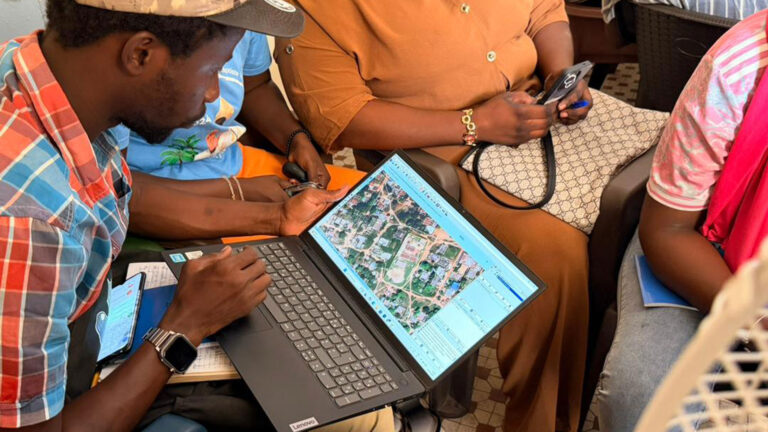
Community-driven settlement profiling, enumerations, and spatial mapping are practices that federations associated with SDI have developed over two decades. These become valuable tools in negotiating more equitable resource flows from the public and private sector to urban poor communities. Profiling is a “top-level scan” of the most important features of the settlement, an estimation of the number of shacks, socio-economic and demographic information and access to services. It is also often times the first point of contact of the federation to a non-affiliated settlement/slum and opens a dialogue on the networking of community structures at the city level to influence city governments. Over the past two decades federations have used this tool to categorise and map out slums in cities. Countries use different questionnaires, data capturing systems, and mapping tools to reach this goal. In order to upscale this data to give a global narration based on credible and community-driven quantitative data, SDI has engaged the Santa Fe Institute, who are supporting a process of standardisation. The goal of this process is apparent upfront: To enhance the federations’ ability to generate settlement information in a standardised format for city, regional, national and global analysis, while maintaining all the social mobilisation characteristics that have made profiling a powerful tool in the first place.
In a two-day workshop between 13 – 14 April 2013 held in Nairobi, federations from Africa and Asia came together to discuss the purposes, community structures and impact of profiling, and to chart the way forward. Jockin Arputham, president of SDI and coordinator of the National Slum Dwellers Federation of India, opened the workshop by reflecting on the progress to date:
This meeting has been called to alert and request everybody to create an action programme for the profile. We all have different questionnaires, although we say we are one family. Settlement profiles need to be captured, and we need to stay consistent in the questions we require. If the country needs more information, you need to add another page. We need one SDI questionnaire, so we can use the information globally. We want to understand what the magnitude of our power is. We want to make different cases to different audiences. We want to collaborate with all the actors speaking about land, housing, infrastructure; all the people speaking about the urban.

This practice first started in India where slum dwellers were exposed to slum eradication in the 1960s and ’70s. Shekar Mulyan recalled the experiences at a young age.
I was born in a Bombay slum, and composition of the settlement was that of migrant workers. My father and Jockin were the first generation leaders. I was six years old when an eviction started that changed the way we would think about organised communities.
Baba Atomic Centre owned the land where we lived. The government recognised the strategic importance of the land, and started planning a large resettlement/eviction process. Jockin was organising protests, but we were failing on all fronts. We did not have any information about of settlement, even though were engaging trade unions, government agencies, and so on. We lost the court case, and the government commanded us to move once again.
We realised that no other community had to go through what we went through. We started thinking about ways to assist communities in similar situations, and how we can best support them. We started counting all the slums in Bombay. This happened over weekends, and there were no resources to support the process. When we compared the numbers the state put forward, and that what we collected, we saw a large discrepancy: the state was always undercounting and minimising the urban crisis.
By creating a “slum dweller perspective” on city planning processes through the practice of profiling informal settlements, groups networking at the city level have better information on their position in the city. City governments often view informal settlements as being “black holes” of demands on state resources; that poor people don’t contribute to the resource base and demand more services and social allowances and grants. This false belief often diverges development capital from poor neighbourhoods towards middle and upper classes, believing that the cost of such infrastructure investments will be recovered through a larger tax base. In this way, cities become more divided, more unequal and the chance of poverty alleviation is seen as a trickle down effect from the market, which has been proven to be untrue.
Alternative views on the organisation and vibrancy challenge these (neoliberal) assumptions of city building. Poor people operate in an economic and social structure that is beyond the control of the state. Here jobs are created, livelihood networks are established, crisis committees respond to disasters, and people build cities from the bottom up. Federations associated to SDI are generating critical information that builds these counter-hegemonic views of the urban poor, rendering a rich and diverse picture of the productive life of slums and slum dweller communities.

Enkanini, Stellenbosch, South Africa Settlement Profile based on Enumeration Map
The experience of the Homeless People’s Federation of Malawi speaks directly to these points as Mphatso Njunga, a federation leader, reflected at the workshop:
We are also using our profiling process to understand the budgeting processes in cities, and we are pushing the government to open up participatory spaces to influence the allocation of budgets. In Blantyre, we were never aware of special budgets to development infrastructure in informal settlements, and now we are more involved. We are also working with universities around planning for upgrading. The profiling helps us to categorise the most pressing needs, and create an action plan.

Moving beyond the influence on state resources towards building critical mass of community capacity and social capital, the experience of the Homeless People’s Federation of Tanzania inspired a lot of discussion between the federations.
I am from a slum in Dar es Salaam and I have been involved in enumerations since the federations started. We started in 2005, which focused on mobilising savings schemes. The SDI team assisted us to build the template questionnaire, and they mobilised two groups. In 2006, we did another enumeration, which was spurred by eviction threats. The government played up the tenants and the occupants against one another, and wanted to evict last mentioned group. The Kenyan team helped us with numbering, measuring plots, and capturing data. (Husua, federation coordinator)
Once communities have generated sufficient “critical mass” and information about slums, alternative democratic spaces can emerge in which the federation has an influence on the flow of resource which determines whether cities become more pro-poor. Brenda from the Zambian federation recalled their working partnerships with government’s structure.
We network with the government’s ward development committee (WDC) and get introduced to the community. The WDC plays an important role in making bridges between the formal and the informal.
We have collected 139 settlement profiles on the total number of 255 slums. This spreads over three cities. Working with the NGO we collect and analyse the data, clean it and process it, and then share it from the bottom up: the community, WDC, city and national minister.
The federations closed the two day meeting on reflecting on the way going forward. Countries agree to a 2 month and 6 months action plan to prioritise profiling in cities. SDI will continue to track the progress and application of this new and emerging system for collecting slum profiles.
The Real Crime Problem Lies in the Formal World


Fears about how slums harbor thieves and criminals reflect the fact that we are looking only at the bottom of the food chain of illegality. Photo credit: Cheryl Marland via Flickr Creative Commons
**Cross posted from Informal City Dialogues on NextCity.org**
By Sheela Patel, Chair of SDI Board
In a guest blog post, Sheela Patel, advocate for the urban poor, argues that if illegal activity is a problem in informal settlements and economies, it’s nothing compared to the rampant crime in the formal world. You can read a different perspective on this issue by clicking here.
As a person working on redefining inclusivity in city governance, I am often challenged by the people who have argued, well and based on evidence, that informality is a menace to a city’s development. And maybe when challenged by it — especially when the face of informality is violent, abusive and confrontational — there is a legitimate case to be made for using police and judicial systems to subdue, contain, or manage it. The challenge we face is to examine where cities will be in the future if this is the only method used to deal with informality.
In many Asian and African countries, urbanization is clearly speeding ahead, and conventional regulatory frameworks that plan cities have clearly not been able to adapt to the global trends and local reality in which more poor, unskilled migrants are coming to cities. With no assets or skill sets, and kinship networks in the same situation as they are, they add to the city’s informality of work and habitat. Most of those in informal livelihoods serve the formal city in ways that we don’t acknowledge. Very few economists have sought to calculate how much they subsidize the lives of those who live and work in the formal institutions.
Traditional markets and vendors who brought goods to one’s doorstep have historically been part of the city. Only now, their numbers are expanding exponentially, and unlike in the past when they melted into invisibility, they are in your face, seeking to live and work in and around the formal city streets and near our homes. Today the vendor and hawker pays the equivalent of thrice what a licensed vendor pays to bribe police and municipal workers; similarly, slum dwellers end up paying for stolen water and electricity – resources that are often stolen by the utilities’ own staff, local politicians and illegal entrepreneurs, and then sold at three to four times their original cost to the slum dweller or vendor.

A woman in Dharavi, Mumbai. Slum dwellers end up paying for stolen water and electricity – resources that are often stolen by the utilities’ own staff, local politicians and illegal entrepreneurs. Photo credit: ToGa Wanderings via Flickr Creative Commons
In the face of industrial and manufacturing sectors being closed down, more and more assembly and manufacturing work is occurring in slums. With no safety nets the poor are forced to explore self-employment as hawkers and vendors, and those who are destitute to take up begging. Is the solution filling jails with people seeking to survive? How will we deal with the situation when another 25 percent of the world’s people come to cities in the next twenty years?
Crime and criminality occur across class and race, and for every petty criminal and thug on the street one could argue that the formal, respectable, upper-class elite steal much more per capita. So fears about how slums harbor thieves and criminals reflect the fact that we are looking only at the bottom of the food chain of illegality. The reality is that the city does not police informal settlements, and being out of bounds makes them safe heavens for bad elements.
Just like transport planning has to move beyond investing in roads only for the private cars that 10 to 15 percent of the city owns, cities too have to be planned for all of those who will eventually end up living in cities. Those of us who see cities gearing up to attract foreign direct investments and imitating European cities where populations are shrinking, or being seduced by Northern planners who produce almost 24th century visions of the city, are accelerating this tension and conflict instead of using planning to create cities that make space for all.
Sheela Patel is the Founder-Director of the Society for the Promotion of Area Resource Centres (SPARC), a Mumbai-based NGO that has been working on housing and infrastructure rights for the urban poor for the last two decades.
Diary on Relocation: Leaving Water Street


By SPARC-MM-NSDF, India
This document is the first entry in a diary of events that unfolded in the first week of November 2012 when several breakthroughs in negotiations between Milan Nagar, a cooperative of 536 pavement dwelling households formed in 1986, and the City of Mumbai allowed for the rebuilding of a partnership between the two stakeholders and an agreement that all Milan Nagar members would be housed in tenement housing through a relocation and rehabilitation process facilitated by the Indian SDI Alliance of SPARC, Mahila Milan and NSDF.
This diary will tell the story of the events and experiences that make up this process. They may not be in a chronological order but will serve as an attempt to document the communications, visuals that the process on the ground in Mumbai.
Negotiating for a Swap
A number of months ago, pavement dwellers reported that people were illegally occupying tenement homes constructed by the MMRDA and BMC for pavement dwellers from across Mumbai. Of course, this created a problem for the families intended for the allotted housing. When this information was presented to the Mumbai Municipality, discussions began as to how to move the “ghuskhors” (squatters) from the tenements so that pavement dwellers could move in. What emerged from this discussion was the realization that unless the entitled households from the pavements were properly identified, empty houses would continue to be invaded in this manner, as the authorities would have virtually no way of knowing the identities of the entitled households.
It was at this point that Jockin Arputham, president of the National Slum Dweller Federation of India, suggested that the pavement dwellers who were meant to move to the land at Milan Nagar, but have not been able to due to complications there, be able to occupy the tenement homes currently occupied by the “ghuskhors.” In exchange, pavement dwellers from other parts of the city will be able to occupy the housing at Milan Nagar once it is completed. This was accepted as a logical and feasible solution.
After getting the support of the municipality and police commissioner, the plan was finalized. The municipality gave a list of the “ghuskhors” to the police, who then removed them from the tenements and remained on the site for several days. In the meantime, Mahila Milan prepared the list of entitled pavement dwellers, as well as all the necessary documentation to make the allotments and undertake the relocation as soon as the “ghuskhors” were removed.
On 5 November documentation of 70 households living on Water Street in Byculla began. Videos of each street were made, photos of every household taken, and all documentation prepared. The households participated with local leaders in the assignment of housing allotments. On 6 November the “ghuskhors” were removed and on the 7th one person from each allotted household spent the night in their new home. At this point, the NSDF team made sure every house had a functioning fan and light after the previous residents moved out. The next day, on 8 November, the first 70 households began packing and were given transportation to move to their new homes. On 9 November the families broke down their huts on Water Street and the next street will begin the enumeration process, get their allotted home and begin to plan their journey.
On the Pavements of Mumbai: Finding Hope & Making Change


Pavement dwellings & daily life in Byculla.
By SDI & SPARC
In the past month a major event has come to pass for the women who began this worldwide movement of slum dwellers nearly 30 years ago on the pavements of central Mumbai. After so many years, the women of Byculla have finally begun to move into their own homes.
In the coming weeks, SDI will cover this important story with a series of blog posts describing the history of Mahila Milan, SPARC and NSDF and how a handful of young professionals connected with a group of women living on Byculla’s sidewalks to create the spark that would eventually evolve into a national, and then international, movement.
This first post in the series will take a quick look what it means to live on the pavement, highlighting the innovation of the urban poor and their incredible capacity to find effective solutions to the challenges of daily life.

Sundar Burra offers a helpful definition of “pavement dweller” in his 2000 paper, “A Journey Towards Citizenship: The Byculla Area Resource Center, Mumbai” :
Pavement dwellers are households who live and raise families on pavements (sidewalks). The basic requirement fo the establishment of a dwelling is a stretch of pavement, free from vehicular traffic, usually 2-3 meters long and 1-2 meters deep from the kerb to the wall of the property bordering the pavement. The first occupation of a stretch of pavement is usually a family settling to sleep on the pavement surrounded by their meagre possessions, followed byt he erection of a plastic or saching sheet stretched from the wall to a point near the curb of the pavement.Thereafter the lean-to tent will gradually be replaced with slightly a more permanent structure of second-hand poles, packing cases, timeber boards, cardboard, occasionally loose bricks covered with plastic sheets. A second floor is often build to provde additional sleepling space, though the ground floor ‘ceiling height’ is rarely more than 1.5 meters and that of the loft a metre.

Please keep an eye on this space for more on the history of Byculla’s pavement dwellers, as well as the story of how the women of Mahila Milan have been able to negotiate for alternative housing in a way that provides a win-win solution for the communities and government alike.
Sheela Patel attends IMF AGM in Tokyo


Sheela Patel at the Annual General Meeting of the International Monetary Fund, held in Tokyo last week.
Pictured: Far Right, Sheela Patel (Chair of SDI). Next to her Jim Yong Kim (President of the World Bank) and second from left Christine Legarde (President of the International Monetary Fund).
At a related event, Sheela Patel spoke about the role of the urban poor in building our urban future:
“I come to this session with a very confused sense of identity. Everyone has a different idea of what a civil society actor is, so perhaps it will be easier to say why we do what we do, and how we seek to influence.
My organization in India, and the international network of organizations that I represent, Shack Dwellers International, represents people who have found that global investment in cities, infrastructure, and other capital investment, have found these processes produce exponential increases in eviction. As a citizen, the right to be provided services, and so on, cities do not plan to accommodate the poor. Most people that work in human rights in this field, will know that the law upholds the development plan of the city. By giving you a notice, the city has the right to evict, without a responsibility to give you anything in return. The inability of having the right to reside, of citizenship, means the civil society movements emerge form people who feel they do not have the rights that they are entitled to.
Why a global network? Because many of the aspects driving these processes including the thinking, are globalised. All finance ministers control the purse strings, most in the South have rural constituencies, and see the city as simply a place to manufacture and produce.
Our architecture is from grassroots up to local. Secondly that the processes to provide voice, has not yet succeeded. Hence our community leaders who have fought evictions and others, eventually we aspire to have them instead of me and professional advocates sitting here, I and others are seat-warmers.
My colleagues are not enabled to speak in these forums, so if you are in the business of development, learn the language of development, rather than force them to learn the language of these places.
My most important lesson is that most instances the government does not know what the poor want, nor how it could be delivered. Treating poor people as consumers of development is a mistake. The poor survive despite development, and can participate in providing new solutions that go to scale if they are part of the process, its execution and design.
Fourth, the whole issue of engendering development – most of our partners were mainly men who used to fight eviction and development. The issue of habitat, creating safe neighborhoods, the responsibility of doing so is also women’s. So what agency are we giving to them? We promote new generation of women’s leaders.
Note, everything that poor people want in cities is ‘illegal or inappropriate’. We produce our efforts to challenge development norms. We have examples of interaction with the WB, and in many instances WB projects involve eviction – termed ‘involuntary resettlement’. We have shown again and again, that involving poor people in design and execution of projects, you succeed in far more successful projects.
Local economies and processes can hugely benefit form participating in this process. Our work is challenging processes, from local to global. We seek a voice, not by saying ‘we have a right to be there’ but by demonstrating that we can succeed by taking different approaches.
We as development actors require new strategies of interaction – one of the biggest challenges is that the world is becoming more urban. Most people in cities will be working and living informally, so how are these exclusionary practices going to impact that, and what does it mean to be this intermediary in institutions or with individuals who seek development.”
For a full report of the event, click here.
Announcing the SDI 2011/12 Annual Report


SDI is happy to annouce our 2011/12 Annual Report, a reflection of where SDI has grown to over the past 25 years. This includes a discussion of SDI’s practices for change, a report on the SDI Secretariat, the building of internal reporting and documentation systems, and SDI’s international advocacy and increasing presence on the global stage. The report concludes with a discussion of SDI’s approach to key urban issues affecting the lives of the urban poor across the developing south, including water and sanitation, climate change, natural disasters, incremental habitat, enumerations and mapping of slum settlements, and financing slum upgrading.
For the complete document, click here.
Relocation & Rehabilitation in Mumbai


**Cross-posted from SPARC’s CityWatchINDIA blog**
What is Relocation and Rehabilitation (R&R)?
Whenever people are being continuously evicted from their land by the government or some other national or corporate authority, families must relocate. Often this happens when the government decides to undertake infrastructure expansion projects like road-widening, flyover construction, rail expansion, etc. and these project plans encroach on families living in public places like slums, railways, and power lines. In these situations the government often tries to uproot these families and move them to remote locations. This process of shifting communities away from public land in demand is called relocation. Rehabilitation involves helping to situate and establish communities in their new homes post-relocation.
In this process of relocating and rehabilitating, SPARC and the Alliance help organize communities and encourage them to be active in planning and executing all relocation activities in partnership with the local government. Initiating dialogue with the families, assisting in the shift, helping with registrations and paperwork, and smoothing the social transition from one neighborhood to another are all part of SPARC’s relocation and rehabilitation program.
Concerns Surrounding R&R
While R&R often serves the wider interest of the city, it leads to hardship for the individuals who are forced to move. For this reason SPARC feels that relocation should be minimized to the extent possible, and when R&R is unavoidable the relocation site should be as close to the original communities as possible. Throughout the R&R process, outside individuals and organizations should be as respectful of the needs and demands of the relocated communities.
SPARC R & R Philosophy and Involvement
SPARC supports communities in the relocation process by giving them the tools to conduct surveys and enumerations in their current settlements and future settlements, establishing savings and credit programs so that families have enough money for the shift, and arranging for inspections of the new locations provided by the government to make sure they have legal utilities available and enough space for all in the new relocation site. SPARC also assists with rehabilitation activities like transferring ration cards and election ID to the new relocation site, updating tax paperwork, arranging for government BEST buses to make new stops at relocation sites, identifying good schools in the new neighborhoods for the relocated children and fighting for affordable tuition for these children, and seeking employment opportunities close to the relocation site for relocated community members. In addition to these activities, SPARC also requires that grievance redressal mechanisms exist at the community, federation, and government levels so that people know where they can go to express concerns.
SPARC believes that communities subjected to R&R must be well-organized and deeply involved in the relocation process from the beginning. Throughout the relocation the state contracting institution and relocating communities must communicate and develop a mutually acceptable arrangement for relocation. SPARC can help facilitate this communication since the organization’s role is respected by both parties.
SPARC’s History of R & R
In 1995 pavement dwellers were included in the list of people entitled to government R&R and SPARC began helping pavement dwellers throughout India relocate onto freed government lands. Also in 1995, SPARC helped design the R&R policy for the Mumbai Urban Transport Project (MUTP), which affected slum dwellers along the railway track. Since then, SPARC has worked with Mumbai Metropolitan Region Development Authority (MMRDA) to relocate these households. In 2000, households from Rafique Nagar along the airport runway were relocated with the Government of Maharashtra’s department of housing facilitating this process. In 2008 SPARC also began working with Tata Power Company to relocate 2,000+ households away from electricity lines so that the company could expand and update its distribution network to provide more reliable power to households throughout Maharashtra.

MUTP: An R & R Success Story
In the 1990s people riding on the Mumbai railway system could reach their fingers out of the rail cars and touch the slums. Slums encroached on the rail lines all up and down the tracks, with some people making their dwellings just a few feet from the trains whizzing by. People living on the side of the railway needed to constantly cross the tracks for daily activities like visiting the markets, walking to school, defecating, or gathering water. Day to day countless people were hit and crushed dead by the trains. Train drivers suffered psychological trauma from killing so many innocent people, even though they drove at only 15 km/hr to avoid as many killings as possible.
One Mahila Milan member, Sulakshana Parab, explained how she lived on a small 6×13 plot on the side of the railway in Tata Nagar, Govandi, with no water, electricity, or toilet access. She would spend her days in constant fear that trains might kill her husband, children, or neighbors while they were out of the house.
Something had to be done, and the Mumbai Urban Transportation Project (MUTP) was the response. MUTP required that 10m of space be cleared and protected by high walls on either side of every rail line. This would enable trains to run safely along the tracks at 45 km/hr, allowing three times as many trains to run through the city each day and one third of the prior commuting time for all those dependent on rail to get to work. With nobody living along the rail lines, many fewer deaths-by-train would occur and train drivers could do their job without killing innocent civilians.
In order for the MUTP dream to become a reality, the city would have to relocate some 20,000 people away from the railroad track. But where could they move? The World Bank agreed to fund the project on the condition that the people living on the side of the railways get relocated and rehabilitated to a safe and permanent location.
Even before relocation was announced, some rail-side communities had began forming into federations to protect women in the community who faced danger of rape and assault when were forced to defecate on the rail tracks because of a lack of proper sanitation facilities. Upon hearing about a possible relocation for all rail-dwellers, federations rallied to organize themselves for the proposed move. First they made plain table surveys and maps and numbered every house in their neighborhoods. Then they assigned individuals in the community to represent every block of twenty households, and registered each of these households so that they could prove the existence of their rail-side homes to the governments. Every Sunday for eight years members of the federation went out to survey lands throughout the city in hopes of finding suitable lands for relocation.
In addition to embarking on these many surveys and enumerations, federations initiated their own savings programs. At first most families could not scrape together 100 rupees of savings, but after participating in well-structured and reliable savings programs implemented by the federation families reached the point of having 15,000-17,000 rupees each stored away in their individual housing savings: enough to construct a new home. The savings programs also enabled people to take out loans in emergency situations or to start their own businesses. With strong savings rail-dwellers became confident that they would be capable of building and funding their own homes if they could acquire a suitable plot of land. Some communities hosted housing exhibitions with model homes made out of cardboard, saris, or cement and other real construction materials to introduce the community-at-large to the various designs that were being considered for the new homes.
Originally the government had planned to temporarily resettle the rail-dwellers in Mankhurd in northeastern Mumbai. The government was not sure who owned the land in Mankhurd, but the federations knew that the land was available because of the extensive surveys they had carried out over eight years. Families began to relocate to Mankhurd, and soon after they settled in there the World Bank adopted a policy that governments undertaking relocation had to provide new shelter for families before their current homes could be demolished. Because the Indian government had not lived up to this demand, the once-temporary Mankhurd land was ruled to become a permanent relocation site for the rail-dwellers.
In total 20,000 people were relocated away from the rail-side under MUTP, and 17,000 of them were assisted in the relocation and rehabilitation process through the work of SPARC, NSDF, and Mahila Milan. In the new Mankhurd relocation site, children are safer since they can play outside without the threat of speeding trains. “Here the kids’ lives and our lives are saved,” Sulakshana Parab remarked. She was relocated from the rail-side to a new apartment in Mankhurd Building 98 and speaks highly of her new home.
The federation in Mankhurd now takes the form of a “Central Committee” of 17 buildings, each of which has its own leader. The Central Committee has done much work to clean the sewage connection and ensure that it stays functional, and they also work on improving the general cleanliness and garbage management of the Mankhurd neighborhood.
When people lived along the railway tracks the threat of trains was petrifying and nobody wanted their sons or daughters to marry into the rail community out of fear that eventual grandchildren would grow up in unsafe conditions. Once the families moved to a permanent and safe location, this mentality changed. Formal buildings made the rail-dwellers formal and acceptable citizens.
When instituted correctly relocation and rehabilitation can be a huge opportunity for families to uplift their living situation, safety, and employment. The key is that communities themselves must provide the energy and momentum to move the relocation process forward, and they must drive the process from its inception. The poor know what kind of solutions will actually address and overcome their problems, and they are capable of making these solutions come to life through proper organization and collaboration.