Sharper Learning Focus: A Culture of Learning By and for the Poor


The end of 2017 marked the end of a four-year strategic planning period for SDI and the close-out of various projects and contracts in support of implementation of that plan. To report on the successes, challenges, and impact of our work over that time, SDI produced a Basket Fund Close Out report, available in full here. In this series of blog posts, we present excerpts from this report that highlight some of the key learnings and impact of our work over the past four years and point towards areas for continued growth in the new Strategic Plan, launched this year.
The first outcome towards which the SDI network was working over the course of the last Strategic Plan was: SDI affiliated federations apply tools for learning and knowledge with sharper focus and rigour.
Throughout the 2013-2018 period, the city learning centers (identified at the outset of the last Strategic Plan) in Kampala, Accra, Cape Town, and Mumbai played a central role in the development of city-wide organizing and partnerships throughout the network. Targeted exchange programs to and from these centers for both community members and their government partners have been central to this effort.
In the Kampala learning center, citywide community organizing and slum profiling and mapping support robust participatory planning forums that have shaped city policy and practice and catalysed the implementation of a range of slum upgrading projects. Learning exchanges to and from Kampala have focused on topics ranging from innovative sanitation technology to construction methods to the development of land-sharing models for inner city land-based finance to large-scale mixed-use development, incorporating both low-cost housing and informal market upgrades to the development of the SDI network’s first youth media team to citywide profiling and mapping of Kampala’s slums. This learning has resulted in the implementation of a number innovative projects within Kampala as well as across the SDI network where federations have learned from the Kampala federation. As a result of this work, an MOU was signed between the federation and the Kampala Capital City Authority (KCCA) establishing an Advisory Committee for Urban Renewal, chaired by the KCCA Executive Director.

In the Cape Town learning center, the federation (FEDUP) and Informal Settlement Network (ISN) have also undertaken profiling, enumeration and mapping at city scale. Enumeration of 18,000 structures and profiling of 106 settlements was undertaken as part of two government tenders, representing both a massive achievement in terms of recognition of the quality of community-collected data on informal settlements, and a distinct challenge in terms of creating a service-provider/client relationship between organized communities of the urban poor and government.
SDI identified Cape Town as a learning center in order to ensure representation of middle income countries with well-resourced cities and highly regularized planning frameworks. Federations in such cities can struggle to be viewed as partners in development and parties to decision-making. A related paradox is that successful community precedents are taken up by the government and replicated, but when replicated the central success element of community participation gets lost (eg. Peoples Housing Process (PHP) and re-blocking).
Some important learning opportunities in Cape Town from the 2013 – 2017 period include the re-blocking of informal settlements to improve accessibility, reduce risk of shack fires, flooding, and crime, and allow for basic service extension; community-led research and enterprise development into clean cooking technologies; open space upgrading to include a drainage system, community halls, children’s playground, and sanitation facilities; a community-driven finance facility that manages contributions from government and donor partners towards slum upgrading projects; and the establishment of a Solid Waste Network with over 350 informal waste pickers.

In the Accra learning center, the federation’s participation in the Cities Alliance-funded Land, Services, and Citizenship Program dramatically increased the scale and impact of its work and made it an important learning center in SDI’s West Africa region. As part of the program, the Ghana federation, GHAFUP, was the lead community partner charged with mobilizing savings schemes at city scale, profiling, enumerating, and mapping Accra’s settlements, establishing settlement forums, organizing communities to participate in city forums, contributing to the drafting of national urban policies, and designing and implementing community slum upgrading projects such as sanitation units, water taps, and footpaths. Exchanges to and from this learning center served to introduce lessons from the Uganda Country Program (TSUPU), and spread these throughout Ghana and into Liberia, to which Cities Alliance introduced a Country Program most recently. Of late, the Accra learning center has been at the forefront of engagements seeking to understand what resilience and climate change adaptation should look like in cities characterized by informality – engaging in rich reflections with government partners on their city-wide profiling data.
Additional important learning opportunities supported by Accra from 2013-2018 include citywide slum profiling and mapping – including serving mapping – making the Ghana SDI alliance a nationally recognised source for slum data and knowledge; the development of an active youth component engaged in data collection, media production, toilet construction, and solar energy, and waste management; precedent setting solar energy and clean cooking projects; and strong contribution to the National Urban Policy Framework and Action Plan.

The Mumbai learning center is unique in its offering for knowledge applicable to working at a massive scale. Mega cities throughout the network look to Mumbai for lessons on how to meet some of the most obstinate issues facing millions of slum dwellers – namely climate change, mega infrastructural investments and their impact on the poor, entrenched inequality and intergenerational exclusion. Highly productive exchanges to and from the Mumbai learning center have resulted in stronger partnerships between federations and city governments and more ambitious aspirations for slum upgrading by these partners, especially in Kenya, Nigeria, Uganda, and South Africa.
Some important learning opportunities supported by Mumbai from 2013-2018 include digitizing of savings records to increase accountability and transparency; incorporation of a vulnerability index into KYC settlement profiles; explorations around the use of solar power to subsidize the cost of maintenance at housing relocation sites; in influencing private sector investment protocols to assess impact on the city’s poorest and most vulnerable.

SDI’s Basket Fund represents a commitment from SDI’s partners to join a global network of slum dweller organizations in their long-term struggle to combat poverty and exclusion in cities. In a development sector dominated by consultants and specialists, SDI adds value as a unique organization channeling resources directly to the poor for the development and implementation of their own strategies for change. This arrangement represents an understanding by SDI’s partners that systemic change won’t be projectized or fall neatly into a funding cycle, but requires long-term multi-pronged collaboration to continuously garrison the gains and push the boundaries.
On both fronts SDI made substantial inroads during the 2013-2017 period. Download the full publication here.
Krishnappa: The black Raaj Kumar has come for your savings
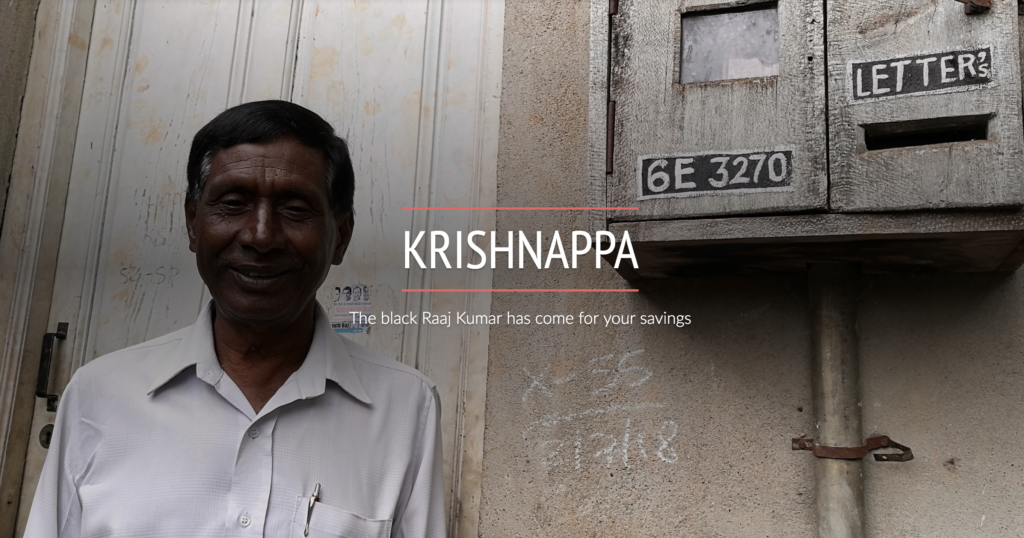

“You must hear this man’s story. He is very good at stopping the land grabbers” says Thomas, a National Slum Dwellers Federation leader, as he gestures toward Krishnappa. Like the rest of us, Krishnappa sits cross-legged on a colorful straw mat squishing the last of his daal and rice together with his fingers. The two visitors from abroad struggle with this technique, but the sari-clad members of Mahila Milan seated around the Bangalore office just smile and insist we have another helping. Krishnappa shakes his head and his eyes sparkle. “Will you tell me?” I ask.
Click on the image above to read the full story.
Private Sector Collaboration for Energy Justice in Mumbai

Organize
As of 2017, the National Slum Dwellers Federation (NSDF) and Mahila Milan in India have organized 694 groups in 81 cities and towns. Home to the oldest national federation in the network, the India SDI Alliance is a critical driver of peer-to-peer exchanges to organize and capacitate federations in Asia and the network at large. This year it became a key organizer of communities looking to find solutions to energy poverty. Success stories of energy-poor communities gaining improved access to renewable, affordable, reliable, and safe electricity through innovative strategies frequently reference rural areas but what of the urban poor communities? How can state strategies for energy security keep pace with the continued expansion of urban populations while at the same time satisfying existing demand? Can the human, financial, political, and environmental assets of the urban poor be harnessed to increase energy security and contribute to city resilience more broadly?

Collaborate
Both Maharashtra State and the Indian Central Government are working hard to incentivize use of renewables in the country’s energy mix. In November 2017, NSDF and Mahila Milan, with their support NGO, SPARC, held discussions with a private sector developer, the state electricity distribution company, and the Slum Rehabilitation Authority (SRA). They agreed to partner on a precedent-setting, community-man- aged pilot project installing grid-connected rooftop solar PV onto government-built, low income city housing projects in Mumbai. This small-scale embedded generation infrastructure will subsidize the energy tariff of the housing’s public utilities, including water pumps, lifts, and corridor lighting, freeing up additional financial resources for use by the cooperative in the maintenance of the buildings. Women from Mahila Milan have been trained in routine maintenance and energy use monitoring of the solar system. Ultimately, the aim is to demonstrate a model that can be locally financed and managed and contribute to energy security and financial resilience for the city at large.
Thrive
As a result of the community’s organizing power, government cooperation, and the help of the private sector, the India SDI Alliance is aiming to reduce the electricity tariff for some of the poorest apartment dwellers in Mumbai. The aim is to install these systems in four more buildings in Mumbai during the first part of 2018. If the pilot proves successful, there are at least 500 such buildings housing very poor relocated or rehabilitated households in Mumbai that could bene t from replication of this project.
The India slum dweller federation efforts are enhancing city resilience by improving access to affordable clean energy, building skills in poor communities, and supporting multi-stakeholder collaboration.
In the coming weeks, SDI will share the case studies from our 2017 Annual Report titled ‘The Road to Resilience’ here on our blog. Emerging from the field of ecology, ‘resilience’ describes the capacity of a system to maintain or recover from disruption or disturbance. Cities are also complex systems and a resilience framework addresses the inter- connectedness of formal and informal city futures. Moreover, it enables a nuanced reflection on the nature of shocks and chronic stressors – recognising that the latter are particularly acute in slum dweller communities and that this critically undermines the entire city’s economic, social, political, and environmental resilience.
As with personal resilience, city resilience demands awareness, acknowledgment of reality, and a capacity to move beyond reactivity to responses that are proactive, thoughtful, and beneficial to the whole. The most enlightened individuals and cities will be those that understand their responsibility to the most vulnerable and to the planet. Our 2017 Annual Report showcases some of SDI’s achievements over the past year on the road to resilience. Click here for the full report.
Inauguration of Solar Energy Project in Mumbai Slum Housing Project

Success stories in accessing affordable, reliable, and safe electricity for the poor are commonly registered from rural areas but what of the urban poor? There is far less real world success in addressing challenges the poor face in cities across the world, limited understanding of how cities will manage the secure supply of clean and affordable electricity for urban informal communities as urbanisation continues, and less precedent for how urban poor residents can play an important role. That being said, organized urban poor communities affiliated with the SDI network are beginning to demonstrate the critical role of the urban poor in practically contributing to clean energy transitions while simultaneously increasing resilience.
On the 28th of November 2017, Mahila Milan and the National Slum Dwellers Federation of India inaugurated a 12kWp rooftop solar PV system on a large-scale government housing complex in Govandi, Mumbai (SRA Building 11C in Natwar Parikh, Indian Oil Compound). SRA is the Slum Rehabilitation Authority, the state level authority administering a government program that provides housing for Mumbai’s poor. The solar PV system installed at building 11C makes use of enabling net-metering policy and a capital subsidy, incentivizing the tapping of Mumbai’s vast rooftop solar potential. Connected to the grid supply the system imports as well as exports electricity allowing the housing cooperative a saving of around Rs. 1.9 lakhs annually (roughly USD 1500).
Communal facilities supplemented by the newly installed solar PV system include: common area lighting, elevators, and crucially the pumping of water from underground tanks to overhead tanks. These energy costs are conventionally borne by levies paid by the building’s residents. A reduction in the cooperative’s overall electricity bill means more money for maintenance. As with other NSDF managed projects, 100% of routine maintenance of the solar system is done by trained Mahila Milan members.
The Indian Ministry of New and Renewable Energy’s Jawaharlal Nehru National Solar Mission aims to position India as a global leader in the production of solar electricity. There’s real momentum in powering the country’s development through an increased use of clean generation sources, reducing carbon as emissions associated with fossil fuel generation.
SDI’s Indian Alliance aims to install these systems in 4 more buildings in Mumbai during the first part of 2018.

For a better Mumbai, fix the slums first


This article was first published in The Hindu.
The government has plenty of schemes for slum redevelopment, but most of these are on paper. Importantly, sanitation is not on the agenda.
I was all of 17 when I migrated to Mumbai in 1967 from Kolar, Karnataka. I didn’t have a purpose then; my only aim was to find bread. I often wondered why I moved to this city. When I look back, I can visualise how millions have the same problem: you don’t have anything, you look out for a metropolis, you land in Mumbai.
I would never have dreamt what Bombay meant. It was a culture shock at various levels. To begin with, I’d never heard the word ‘slum.’ Moreover, the language was alien, and we had open-air, ‘airconditioned’ toilets.
A week after I landed in the city, I ended up in the thickly-populated Janata Colony, Mankhurd. Conditions were pathetic. If I needed to use the public toilet, I would have to queue for nearly 20 minutes. So I would end up squatting wherever I would find place.
I was in a slum, but I had no home. In fact, I had zero liabilities and assets, no roof over my head, no roots. I would sleep anywhere.
One of the good things about a slum is that no one ever chases you away from their doorstep. In the day, I would mark out a veranda where I could lay my head at night. I would pick up saris hung out to dry and use them as blankets. In the morning, I would go to the public tap, remove my clothes, bathe, dry myself with the same set of clothes and carry on with the rest of my day.
The questions in my head were ceaseless: how did I fall from the frying pan into the fire? For the first time ever, I saw pavement dwellers. Why did we all have to live like animals? I gradually learnt about eviction and demolition. And then about homelessness. Where could one live? I figured there wasn’t much of a choice.
My journey had begun; I needed to do something about all this. From then on, I have been organising people, taking up issues of slum sanitation, eviction and demolition, and trying to find solutions.
It’s important for me — for all of us — to talk about our slums. There is an entire section of society living in deplorable conditions, because of which the city’s health and economy are being dragged down.
The way things are, there is no collective vision; no rules either. Nearly 60 per cent of Mumbai lives in slums, but a good chunk of the municipal corporation’s agenda is devoted to gardens, roads, parking and so on; the slums don’t feature. In our lopsided system of political representation, slum dwellers have been relegated to a vote bank. They are patronised, and encouraged to live in deprivation.
Look at Dharavi, for instance. The government has no policy for Asia’s largest slum. In the past 15 years, there has been no development in terms of roads, drains, toilets, or common areas. The main road has seen encroachments, encouraged by a former politician.
Clean the city, build toilets
Mumbai lets off a big stench. People call it Slumbay. What are the reasons? Poor sanitation and environment, contaminated drinking water and crowded conditions.
Even today, 40 per cent of people in Mumbai don’t have access to a toilet. In Dharavi, 33–35 per cent of people live in 60-sq-ft areas. We’re talking about five-member families living in that space. How can you think of having individual toilets there? The airport slum doesn’t have a single toilet. How long will this continue?
Mumbai needs sanitation that is not dependent on the sewer system alone. Sewerage systems require a capital cost, which the government cannot afford. And the rehabilitation of people will cost them 100 times more than their investment in sewerage lines. Nearly 65 per cent of Dharavi is not covered by a sewer system. To do so, you need to rehabilitate 80 per cent of the people living here.
Everyone is talking about Swachh Bharat, but how many toilets have been constructed in slums under this project? The government could have claimed it had cleaned Mumbai, so working with smaller cities would be relatively easier. You have to show what you have done in a difficult situation first.
Our sanitation needs to be customised to our living and weather conditions. Unlike the West, we cannot afford individual toilets or sewer lines.
We have to work towards providing collective, shared and community toilets. We can achieve two agendas at one go: if the municipality invests money in a slum (in the form of toilets) it cannot demolish it.
The main focus should be on how to clean the city. Without getting into the politics of it, we need to ask if a mechanism has been created for the purpose. Even after we have created wards, there is nothing to show on the ground. Where and how is the money being used?
A city like Mumbai should have had an IAS officer as the head of sanitation. Every area needs a dedicated sanitary inspector, with the additional role of mapping the area and reporting to the higher authority.
Alternative housing
In the 80s, there were around 600 slum pockets in the city. Now it has gone up to 3,000.
No one comes to Mumbai for the pleasure of getting a house in a slum. They are in tough situations, therefore they migrate. We need to address the needs of those already living in slums by giving them better housing. We need to do away with the dehumanised category of ‘shanty’.
Former Municipal Commissioner S.S. Tinaikar used to say, “Mumbai has so much land, you can arrange to have another city like it.” Land needs to be given to the people, but not for free.
The Development Plan outlines a clear policy of homes for the dishoused. There is also a pavement policy, which former Secretary, Special Projects, Sanjay Ubale and I hammered into shape. The subsequent Government Resolution said all pavement dwellers are eligible for a house, just like slum dwellers. I was able to secure 4,710 sq.m. land for rehabilitation in Mankhurd.
There are policies, but the government is sleeping on them, while the people don’t have anyone to organise them into agitating for their due.
The government often says it can’t give land because it is reserved. So I tell people, let every slum- or pavement-dweller identify 10-15 pieces of land. If they say it is reserved for a university, ask for a third, a fourth, and so on. After 220 land reservations, can they still say no? There is land, only the will is missing.
Over a decade ago, I was working with the MMRDA on the Mumbai Urban Transport Project-II. I told the Sukhtankar Committee that the government could float a tender asking for free housing on the land in the project. The first housing scheme was initiated by us. All 20,000-30,000 families have been rehabilitated on it. That means the MMRDA has the land and houses.
The Slum Rehabilitation Authority (SRA) has failed because of corruption and mismanagement; it has become a money-making mission for the government.
The first question a councillor asks these days is, “Isme mera kya hai? [What’s in it for me?]” You have 365 cooperative housing societies built under the SRA, but most of the residents have had to dedicate 20 per cent extra, or out-of-pocket expenses, like paying someone to approve a document, an extension, or adding a name to a registration. That’s why these societies have taken in only 150 families.
In an SRA house, you are charged more than five times what you pay in a slum for water. Do you expect a rehabilitated person can pay that much? An SRA home, then, is not affordable. Nobody is going into why the SRA scheme hasn’t picked up in Mumbai, and why there are so many slums. They have set 269 sq.ft. as the base under the SRA, and 300 sq.ft. in Dharavi. But a political party wants 400 sq.ft. Once this is done, airport slum dwellers will demand the same. This doesn’t just involve finding land; it’s also a question of rehabilitation.
The government is doing nothing for affordable housing, which in any case costs Rs. 5 lakh and above. Besides, most ‘affordable’ homes are outside the city, or in far-flung areas; this requires the creation of a transportation network.
Our politicians and bureaucrats have learnt nothing from the mistakes of the SRA or rehabilitation over the past 35 years. Therefore, we live with myths like ‘there is no land’. To begin with, slums are on the ground level. In urban India, you cannot afford to live in a ground-floor structure, simply because the land cost is so high. You compensate for that by getting into an SRA house. But if you want to live here, you have to change your living pattern. You live without a toilet for years; you don’t talk about it.
I’m not asking everyone to go to an SRA accommodation. Regularise or recognise a slum and maintain a standard; instead of a corrupt SRA society, slums could be more organised. We also need a housing guideline.
Other fixes
Women must be at the centre
Local residents, particularly women, need more representation in decision-making. For every issue, be it toilets, housing or water, women are worst affected. A man can meet his needs outside the home: he can use the toilet in his factory, or a public toilet. In most cases, women are tied to the home; their representation is token.
Use NGOs better
Today, you have more than 6,000 non-governmental organisations (NGOs) registered with the Charity Commissioner. Every ward could be allotted 10 to 15 NGOs for specific issues of their choice; this will fix responsibility. The government could create that kind of flexibility, by inviting a ward’s prominent NGOs to a meeting and assigning them duties. A coordinating body could be responsible for their functioning.
In other words, identify the issue, then create a system and then monitor it, all within a budget.
NGOs, on their part, need to raise the issue of sanitation in their wards. For now, they are just “talking revolutionaries” who often don’t get down to hard work.
Generate debate
The government should take these issues to the people, create forums where debate can happen without fear of reprisal being targeted. Right now, there is a disconnect between the grassroots and the policy-makers.
What you see today is the result of the administration not looking after the city. Mumbai is actually well organised, with every inch of land governed by the administration. They ought to be more in control of encroachment though.
There is a Hindi saying: ‘Billi ki nazar chichde mein rehti hai [The cat always looks for the cream]’. Similarly, the politician always looks at how many votes he can garner in an area. He never looks at problems like housing or a poor living environment.
About the author
Jockin Arputham has worked for more than 40 years in India’s slums, building representative organisations to partner with governments and international agencies for the betterment of urban living. He is president of National Slum Dwellers Federation, which he founded in the 1970s, and of Slum Dwellers International, which networks slum dwellers from over 20 countries. Arputham received the Ramon
He was awarded the Magsaysay Award for Peace and International Understanding in 2000.
Indian SDI Alliance Awarded 2016 Curry Stone Design Prize


Today the Indian SDI Alliance, made up of the National Slum Dwellers Federation (NSDF), Mahila Milan (Women Together) and their support NGO, SPARC, will be awarded with the 2016 Curry Stone Design Prize Vision Award at the National Gallery of Modern Art in Mumbai.
The Curry Stone Design Prize is a highly recognised social impact design award, celebrating engaged practitioners and the influence and reach of design as a force for improving lives and strengthening communities. The Vision Award recognises individuals or organisation s that have significantly inspired the design profession and the communities they engage through their continuing commitment to social impact design.
Yesterday, in the lead-up to the award ceremony, SDI President Jockin Arputham (who is also president of the Indian NSDF) and Sheela Patel, chair of the SDI Board and executive director of SPARC, spoke at the Curry Stone Design Prize Forum, a one-day symposium examining the role of design in facing the challenge of urban poverty. They were joined by former awardees and experts in the field of urban planning and design.
Visit the Curry Stone Design Prize website to learn more about the Indian SDI Alliance’s award-winning work.
Jockin Arputham Awarded Person of the Year
 [caption id="attachment_11349" align="alignnone" width="500"]
 Jockin Arputham the Person of the Year Award Function at VIT Vellore, Tamilnadu. Pictures by H.K.Rajashekar.[/caption]
On 9 March 2016, SDI President Jockin Arputham was awarded VIT Person of the Year by VIT University Business School (India). The below excerpts are taken from a piece featured in The Weekend Leader about this prestigious award.
**
He started off with his trademark declaration, “I am a slum dweller,” and for the next 20 minutes went on to narrate his story, of how he landed in Mumbai as a teenager and went on to emerge as an activist who fought for the rights for the urban poor transcending national borders.
The founder of National Slum Dwellers Federation (NSDF), and president of Slum Dwellers International (SDI), Jockin Arputham, 68, was speaking at a function held at VIT University, Vellore, Wednesday after receiving The Weekend Leader – VIT Person of the Year (2015) Award.
Seeking to motivate the students to think about improving the lot of the poor living in the country, he recalled his first activism in Mumbai when he led 3,000 children from a slum and dumped the garbage each of them was carrying at the Municipal office.
When the police came looking for him, he told the cops that since the Municipality had failed to collect the garbage from their colony, they resorted to this action. From that day on, the Municipality started to collect the garbage from their settlement and Jockin emerged as a leader.
“Today I work in 37 countries. I am not (just) a slum dweller, but I am a flying slum dweller. Morning I am in Mumbai, next morning in Nairobi, and (for) dinner (I am) in America,” he said.
Dr. Prateep Philip, ADGP, Economic Offences Wing (EOW), Tamil Nadu, who pioneered the Friends of Police movement in the state during the 1990s presented the Person of the Year award to Jockin and urged the youth to excel in their chosen fields.
*
To read the full article, click here.
Improved Sanitation Improves Half a Million Lives in Pune, India

By Maria Lobo and Mahila Milan
Background
Sanitation has been the shame of India. More than 50 percent of people who still defecate in the open live in India. Most of these are from rural areas but many of them are urban slum dwellers. Public toilets, though available, are all too often so rundown and filthy that defecating in the open remains preferable. This affects the overall health and dignity of slum dwellers, especially women. The following is a demonstration of a bottom-up advocacy approach to sanitation which is led by the community themselves. This experience challenges the mindset of people who seldom think of slum dwellers as capable of bringing change from below.
Community Toilets in Pune
In Pune, a partnership between the municipal government, NGOs and community-based organisations has built more than 400 community toilet blocks between 1999 and 2001. These have greatly improved sanitation for more than half a million people living in slums. They have also demonstrated the potential of municipal community partnerships to improve conditions for low-income groups.
How it all began
Based on the discussions of female slum dwellers, specifically around the challenge of open defecation, the Indian SDI Alliance (NSDF, Mahila Milan and SPARC) prioritised addressing the sanitation challenge. Given the huge problems in dense, inner city slums and the lack of formal sewerage connections the community toilet block was tabled as a solution that promoted access to sanitation In the absence of safe disposal of faecal matter through the sewer connectivity, safety tanks were the next best option suggested .Over time, the alliance built many such community toilet blocks, initially with grants to develop, design, and get acceptance from community groups and municipalities in over 20 large and medium cities across India. In all locations, they began to explore where they could locate a municipality that would take on this strategy at a significant scale.
The first possibility arrived in 1994. The World Bank began negotiations with the Municipal Corporation of Greater Mumbai (MCGM) to seek a loan for a large sewage treatment project in the city. This mega-buck, mega-infrastructure project involved a large-scale expansion of Mumbai’s undersized and overtaxed sewer system. Thanks to pressure from local NGOs, the World Bank set one condition for the loan – that the project also address the needs of the poor and, to the Indian Alliance’s delight, include the building of community toilets in a selected group of slums. The project set a target of providing 20,000 toilets, enough for at least a million people at the less-than-perfect ratio of one toilet for every 50 people. When the Alliance was invited to explore ways to get involved, it saw a chance to test some of its ideas about community-managed sanitation at a much larger scale, and to strengthen a constructive partnership between the urban poor and the city government. While the Alliance was keen on community participation in taking up this project, the World Bank had the different approach of setting up a competitive bidding process which pitted one community against another to be chosen for demo projects. In addition the overall procurement strategy did not work for the alliance. So with some regrets the alliance withdrew from this project at that time.
In 1999 the Municipal Commissioner of Pune, Ratnakar Gaikwad, who co-incidentally had been the additional (deputy) commissioner of Mumbai Municipal Corporation while the community toilet project was under discussion, invited the alliance to work in Pune. He devised a sanitation program for the city of Pune based on the strategy developed by the alliance. It was set up in several stages. Since 1992, only 22 ‘pay and use’ toilet blocks had been built in the city of Pune. A decision was thus taken to construct around 400 community toilet blocks in two phases starting in 1999. NGOS were invited to apply for a fixed price tender and get contracted to organise communities to design construct and manage community toilets. A formal commitment was sought by the municipality that the NGO and the community would maintain the toilet block by collecting contributions from the community. The contracts were not only for building toilets but also for maintenance. In awarding contracts, priority was given as follows:
i) settlements of more then 500 inhabitants that had no toilet facilities,
ii) areas where facilities were so dilapidated that they needed replacement
iii) areas where there were toilets but a larger population was forced to use them as against the standard norm of 1 seat for 50 persons.
Bids from eight NGOs were accepted, of which SPARC was one of the selected NGOs.
Meetings in every locality in Pune were organised by Mahila Milan. In the beginning, there was a lot of hand-holding. There were engineers and architects stationed in Pune who were always available for advice and guidance. Every site would be visited every day by an engineer who would sort out problems on the spot. There were regular visits by a team from Mumbai to give overall direction to the programme. Masons and carpenters with experience from within the slums were supported to take on jobs, along with regular contractors. There has been considerable debate about how best to fund the maintenance of these toilets. The Indian Alliance promoted a system whereby each family would buy a pass costing 20 rupees a month. This was based on the income required to cover the costs of hiring a family (who would live in a caretaker’s room above the toilet) and costs of cleaning and maintenance materials. This is much cheaper than the one rupee per use charge used by other public toilets which for a family of five would cost 150 rupees a month even if each household member only used the toilet once a day.
From the beginning the urgency in the project was based on the realisation that the Commissioner was a project “champion” and this project had to be completed during his tenure in Pune. Everyone was learning as they raced around getting things done. The downside of this was that many mistakes were made, and repairing them cost the Alliance resources that the city would not provide. The reality, however, was that if we had hesitated, we would have lost the chance to do this project and to learn from it. It’s a difficult choice but often when working on issues concerning the poor, plunging into untested waters is the only way to produce precedents. And a precedent was established in Pune, as the first location for community toilet construction at a city-wide scale. The program took off in a big way and virtually all slums were provided with toilet blocks (https://www.youtube.com/watch?v=CVggpF3651Q).
As soon as the sanitation work in Pune took off the Indian Alliance began to once again focus on Mumbai but the World Bank and the municipality continued to go back and forth on how to proceed with contracts. Finally the procurement policy was finalized and the Alliance agreed to take part and their experience of working with slums was made a critical factor in the tender point system. The Alliance got the contract to construct toilet blocks along with two other NGOS in Mumbai. As part of the Mumbai Sewerage Disposal Project, which started in 1999 and is still ongoing in different phases, the Alliance has constructed, to date, 366 community toilet blocks with 6952 seats.
Later, Ratnakar Gaikwad was appointed director of YASHADA, a national training institute for government officials based in Pune. Discussions between his office and the Alliance led to a seminar that included NGOs, government agencies, training institutions, and other institutions that wanted to work on urban sanitation and to create a collective boost to their various efforts to address open defecation.
The work undertaken by the partnership of the Alliance, YASHADA and Administrative Staff Collage India (a major institution that does research and trains a wide spectrum of private and public administrators) opened the possibility of working in some new cities. But it went both ways: these city processes were fed back as examples in the training and capacity-building sessions that were being held in the two training institutes. In all of these cities, as in every other experience, the Alliance had to struggle for several years to be fully paid for its work.
Tirupur followed Pune and started a sanitation programme in 2004, where the Alliance along with a private sector company (who was contracted to undertake infrastructure projects) constructed 14 toilet blocks with 254 seats. Nineteen community toilet blocks were later constructed in Vishakhapatnam, a port city of Andhra Pradesh, between 2004-2005; these blocks included 232 seats. Vijayawada is a medium-sized town in Andhra Pradesh. The sanitation project here started in 2004 when, at a national sanitation meeting, the commissioner of Vijayawada heard about the Mumbai sanitation project and invited NSDF to work in the city. Seventeen toilet blocks with 128 seats were constructed for a population of 6,400. In 2006, Pimpri Chinchwad Municipal Corporation contracted Pune Mahila Milan to construct 7 toilet blocks with 90 seats to initiate its sanitation project. The project in Pimpri reflects the importance of building demonstration pilots which can be picked up and expanded upon. In cities where the federations have the capacity to operate at scale, they can handle the expansion phase. In 2007, a project called Nirmal MMR Abhiyan (Campaign for a Clean MMR) designed a strategy to finance community toilets in slums in Mumbai and 13 other municipalities.
Impact
This programme helped to reconfigure the relationships between city government and civil society. NGOs and communities were neither “clients” nor “supplicants”, but partners. The city government recognized the capacity of community organizations, supported by local NGOs, to develop their own solutions. The division of roles was also clear in that city authorities changed their role from being a toilet provider to setting standards, funding the capital cost of construction, and providing water and electricity. The NGOs and community organizations designed, built and maintained the toilet blocks.
It was only after they had started working in Pune in 1998 that the Alliance re-entered the fray in Mumbai, where the World Bank was still committed to a competitive bidding process and where the slum sanitation part of the huge sanitation project continued to face challenges from all sides. After the success of the Pune model and project, the Alliance was contracted to construct community toilets in slums as part of the Mumbai World Bank project and all procurement procedures were redrafted.
In 2000, the Pune municipal commissioner and the Indian Alliance were invited to make a presentation to the prime minister’s office. A Nirmal Bharat Abhiyan programme was announced and the Planning Commission dedicated funds to cities that want to take up sanitation projects (Nirmal Bharat Abhiyan in Hindi means “Mission to clean India”). The planning Commission is the highest Planning institution in India. Between 2000-2008, a partnership between the Indian SDI Alliance, YASHADA (training institute of the government of Maharashtra), ASCI (Administrative Staff Collage, Hyderabad, Andhra Pradesh), and the World Bank Water and Sanitation Program led to the inclusion of slum sanitation in the training of many city officials. In 2009, after national and state-level consultations, development of city-based indicators and state government agreements, the cabinet passed the national policy for urban sanitation. In retrospect the volume of interventions desired did not take place. In many ways essential recommendations ( e.g. city wide data to create benchmarks for deficits) were taken up but instead of facilitating communities and municipalities to undertake this, the process was assigned to consultants. In this manner over 400 such surveys and follow up projects were prepared but the delivery of sanitation did not occur.
Community based organisations and alliances face the challenge that the production of a sanitation solution and working to set precedents works effectively at a settlement and city scale. However once the process seeks to take a quantum leap to become nationally embedded it gets appropriated in ways that excludes the community champions that drive it.


Without Power: Mumbai’s Pavement Dwellers


With no electricity, kids study under a street light at night.
**Cross-posted from the SPARC/MM/NSDF blog**
If you can read this, you’re not affected. For most urban dwellers electricity is available at the flick of a switch, to power our numerous appliances from our coffee machines to our computers and TVs, but not for all: many of the urban poor still have no access to electricity although the power cables are literally just two meters above their heads.
In the new Energy Justice program of SPARC we have just recently started a survey in order to better understand the needs and problems of the urban poor related to energy. Last week we have been at a settlement of pavement dwellers next to the Western Express Highway in Goregaon, Mumbai who have lived there for at least the last 10 years. Although none of the households have access to electricity, they have energy expenditures between 300 and 750 Rupees per month just to be able to illuminate their homes in the evening with candles and to charge their cell phones at the next kiosk. This costs them between 10-15 Rupees daily.

Pavement dwellers at Goregaon Western Express Highway.
It is hard to believe, but most of Mumbai’s households have to manage with less than a dollar per day per capita, some of them even with half a dollar. It’s no wonder then that these households seek to avoid spending any money where it is not absolutely necessary and therefore cook their meals on traditional three-stone-stoves. Because most of the men work as casual laborers and are out of the house, it is the task of the women to collect the wood which lasts between 1 and 2 hours every day. Cooking with open fire or on three stones is not only time intensive but also health threatening as the smoke causes respiratory diseases. And this is not done with a cough – the Worlds Health Organization (WHO) estimates that annually more than 4 million people die because of cooking with solid fuels, of which 50% are children below the age of 5. (http://www.who.int/mediacentre/factsheets/fs292/en/)
We have started our new Energy Justice program in order to develop solutions jointly with the urban poor that will provide better access to modern energy and reduce costs. We will keep you updated here about the further development of this project.
Author : Vincent Moeller is working for SPARC as an advisor on Renewable Energy and Climate Change since June 2014.
Ongoing Saga of Slums Along the Airport in Mumbai, India


**SPARC Responds**
The slums along Mumbai airport with over 98,000 structures remain a crucially unsolved challenge for the development of the airport. The residents networks that are part of NSDF city federation have long stated that they are willing to conceded land that the airport wants for its infrastructure as long as the land not needed for this will be made available for them to live in SRA ground plus 5 buildings.
For many years the contract to build alternative housing for slums along the airport was given to a construction firm HDIL. The deal was that 276 acres of encroached land would be “cleared” as households would move to sites nearby.
The unusual act of getting transferred development rights for the 7,000 structures in which no one has moved yet has been noted by the CAG in his report.
Many other challenges also impeded this process.
- The state cannot undertake surveys until it clears eligibility norms, which should be structure for structure, but the High court only says 2,000 cut off is acceptable. So only a very small percentage are eligible.
- Residents what to be assured that all get houses nearby but only 7,000 are nearby so they won’t budge.
- The deal for GVK and HDIL does not become profitable unless the land use for commercial purpose is accepted. Which means there is a stand off.
In the meanwhile the new terminal with huge array of art work is to be opened in February 2014.